Wednesday, June 10, 2015

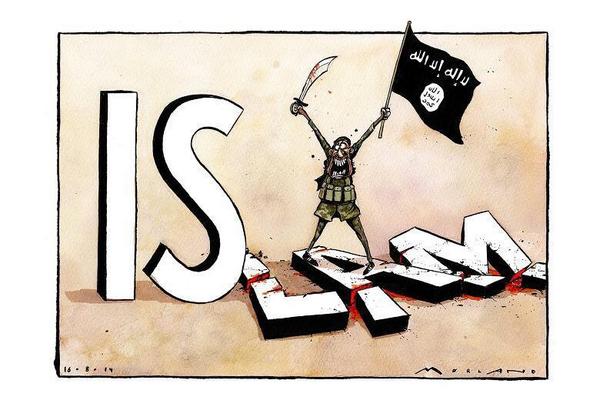
ISIS and slavery: a state of “Islam” before the Qur’an

Amsha Alyas, who escaped ISIS after her husband was killed.
She was sold to an ISIS commander.
Mashable.com

TWO-hundred and twenty-one years ago the Portuguese slave ship, the Sao Jose de Africa, set sail from Sofala in Mozambique with a cargo of 400 slaves. Captured in the Zambesi lowlands, the live cargo was destined for the markets of Brazil.

In 1794 the idea of transporting east African slaves across the Atlantic marked a significant shift in the brutal industry, a shift that would prolong slave trading between Africa and Brazil until 1865 – and see nearly half a million Mozambicans dispatched to the country’s sugar plantations.  

After having rounded Cape Point in late December, the Sao Jose hugged the coastline to avoid a storm and struck a rock off modern-day Clifton. It broke up and sank in shallow water about 200 metres offshore. Tragically, 212 of the slaves were drowned in the icy Atlantic after the crew were unable to rescue them.

The remaining 200, who’d survived the terrifying ordeal, were herded together on the beach and sold in Cape Town. One can only imagine their trauma: the lot of slaves at the Cape makes for miserable reading. Slavery was grossly exploitative, cruel and contrary to any concept of human dignity.

With our slave origins in Cape Town this is something that as South Africans we should be painfully aware of. In the 21st century being free from slavery is an entrenched human right – which makes it surprising that any modern nation state – let alone a “Caliphate” – should endorse it.

Yet ISIS in 2014, enforcing its Islamic “state” at the point of a Salafi-Wahhabi gun, had issued a document, via its Research and Fatwa Department, which – astoundingly – endorsed the slavery and sexual subjugation of Yazidi, Christian and Jewish women due to them being regarded as kuffar, or people of unbelief.

Questions of their “unbelief” are, of course, questionable. But that Yazidi women had indeed been enslaved by ISIS was confirmed by Human Rights Watch and Bristol University, who spoke to women who’d escaped the clutches of their rapacious captors. The BBC ran with the story and Al-Jazeera reported that girls were being sold in Mosul.

For any Muslim, this bizarre retrogression by ISIS is as baffling as its understanding of Shari’ah. Tahir ibn Ashur, the famous Tunisian scholar, once said that the maqasid (the noble goals of Sacred Law) indicated that equality was one of its objectives. Shaikh bin Bayya, a legal giant of contemporary Islam, has said the maqasid emphasises that freedom is an essential human right.

With ISIS hankering for a rose-tinted return to the past – and specifically the era of the pious forbears, the Salaf us-Salihin – one can only assume that their literalist reading of the texts has let them down again.

Slavery was indeed the status-quo of the Quraish who ruled Makkah at the time of the Prophet, but to say that he approved of slavery would be mistaken. Islamic scholars observe that the Qur’an, which Muslims believe has the final say on such things, is a thoroughly pragmatic work. This is because the Qur’an recognised that deeply embedded cultural institutions, such as slavery, could not be eliminated instantly with the sweep of a single verse.

The great elders of Qur’anic exegisis – or interpretation – tell us that Qur’anic verses have special qualities of meaning such as “specific” and “general”. They also have qualities of abrogation (naskh): in other words, one verse can out-rule another.

The abolition of intoxicants is a good example, and shows how the Prophet used gradualism to spread his word, rather than harsh reactivism. For instance, 2: 219 posits the undesirability of alcohol, but does not abolish it. In 4: 43 we get the suggestion not to come to prayer when intoxicated. Only in 5: 90 is alcohol completely forbidden.

For literalists like the Salafis, some of whom who spurn classical methodology and metaphor, there are obvious contradictions when it comes to intoxicants and prayer. On the issue of slavery it appears as they’ve reverted back to the default position – a state of Islam before the Qur’an – when slavery was accepted as an unquestioned status-quo.

The point is that Qur’an questions the institution of slavery from the get-go. However, the word of Allah is subtle, it realises that turning a society upside down short-term will not result in long-term reform. So what we get this time is a thematic thread weaving through the Holy Book from its second chapter right to the end.

In 2: 177 we are told that to free a slave is a practical deed of charity; in 4: 92 freeing a slave becomes an act of restitution for the mistaken killing of another Muslim; in 5: 89 freeing a slave is expiation for a false oath; in 9: 60 there is a reminder of the charitable act of freeing a slave; in 58: 3-4 expiation emerges again and in 90: 13 man is reminded that one of the most noble signs of justice is freeing a slave.

The Hadith of the Prophet also show that freeing slaves was a popular means of expiation. That the freedom of one slave could be equal to months of fasting – and even the feeding of 60 poor people – is an eloquent enough suggestion of its charitable merits.

A ruling, via Qur’an, that a slave woman would only receive half the legal punishment of a non-slave woman, that a portion of zakat (alms tax) should go towards freed slaves and the order (in 24: 33) for masters to help their freedman financially, is proof of a compassion towards slaves that did not exist historically before.

Unfortunately, reports from Iraq and Syria appear to contradict all of the above with regards to ISIS. Their evident return to an era of darkness and ignorance is inexplicable given the overwhelming body of scriptural evidence against reverting to slavery, and the fact that the Prophet was essentially an abolitionist, a man who believed that liberating a slave was like bringing a human being back to life.

Monday, May 25, 2015

ISIS is calling


THE notion that the Islamic State (ISIS), or Da’ish, would not extend its reach to South Africa has proved a false one. ISIS, which controls swathes of Iraq and Syria, has persuaded thousands of gullible youths from all over the Muslim world to migrate to its self-declared Caliphate.

This breakaway group from Al-Qa’idah has turned Islamic extremism on its head. Unlike Al-Qa’idah, which has focused on a “distant enemy” from caves and compounds, ISIS controls actual territory and has an active militia.

And whilst Sunni scholars world-wide have condemned ISIS for its heartless parody of Shari’ah, or Sacred Law, and its notion of an “Islamic State”, it has not prevented it from becoming an ideological reality bolstered by extensive social media support.

Its online magazine, Dabiq, presents a glowing depiction of jihadist utopia. But the gloss disappears when the Caliph urges Muslims to rise up and kill “crusaders” (Christians and Jews).

Essentially, ISIS’ message is that Islam is under threat everywhere; the world is a Dar ul-Harb, a place of hostility, and ISIS offers the only Dar us-Salam, or refuge. “If you don’t agree with us, you’re against us” is the gist of the worldview, which means that as a Muslim if you disagree with ISIS you become a kafir – an unbeliever whose blood, in their eyes, it is permissible to spill.

ISIS also promotes an apocalyptic vision of Syria, and claims that it is waiting for the end days and the final Islamic Armageddon when a leader, the Imam Mahdi, will appear.

ISIS rose after 2003 – and the US invasion of Iraq – as an Al-Qa’idah affiliate led by Abu Musab Al-Zarqawi. He was a Jordanian jihadist with a criminal record, who refused to swear allegiance to Usama Bin Laden, and whose brutality even stunned Al-Qa’idah.

The rot was started by the Bush administration when Paul Bremer, the US presidential aide in Iraq, fired 250, 000 civil servants and government forces. Bush’s incompetence in then imprisoning many Iraqi officials created a political sinkhole into which the whole region collapsed as Iraq disintegrated.

Interestingly, General David Petraeus – who was sent to Iraq in 2007 as “Mr Fixit” – told the Assad regime that its sponsorship of a Salafi insurgency to undermine the US would come back to haunt it. Nouri al-Maliki’s government (2006-14) caused further resentment when he condoned Shi’ah sectarian patronage and allowed political neglect of the Sunnis.

It is more than anecdotal, reports the German magazine Der Spiegel, that the structure of ISIS was developed by a bitter, unemployed ex-Baathist intelligence officer, Colonel Samir al-Khlifawi.  Like so many Iraqis, he’d been quietly waiting to seize the day.

However, post-analysis does not serve present realities in South Africa. This is because although ISIS does have a decidedly limited appeal here, a few South Africans have been seduced by its propaganda and have travelled to Syria either to fight with it, or to migrate permanently.

In recent months, swirling speculation and rumour has coalesced into fact. In South Africa, ISIS is calling.

The first instance was earlier this year when the Daily Maverick interviewed via social media an “Abu Hurayra” from Gauteng, who claimed to be fighting with ISIS, saying that another South African “Abu Baraa” was with him.

Last month a teenage girl from Kenwyn was apprehended at Cape Town International airport whilst en-route to Syria. Hailing from a middle-class home, it emerged that she had been active vis-a-vis ISIS in social media. Someone who knew the family described her as intelligent, focused and difficult to dissuade.

With the family closing ranks, it has been a tough lead to follow. In addition, state security has either been unable – or unwilling – to explain to the media who gave the girl, a minor, guardian’s consent to board the plane. It is a missing link in the narrative. The question is: who was her handler?

A Spanish journalist following the story, Jaime Velazquez, believes that part of the answer might lie at school, but that doors have closed there too on the possibility of an educator playing a role.

In May the Roshnee community near Johannesburg was rocked by the revelation that more than 20 of its members had left for Syria. Eleven were arrested by the Turkish authorities and deported, but the rest reportedly got through.

A meeting expressing public concern was attended by over a thousand people at a Roshnee mosque and was addressed by local scholars, who explained to the congregants the theological pitfalls of the Caliphate.

Shortly afterwards, the Lenasia-based radio station Channel Islam International (Cii) received a letter, allegedly penned by South Africans with ISIS, criticising the scholars and telling them “to see for themselves” and not to believe the western media.

Close on the heels of the first letter, Cii published on its website an e-mail from a Rashid Moosagie, believed to have been from Port Elizabeth, and a member of another group that had reportedly migrated to Syria and the “promised land”.

In a rambling diatribe against what he perceived as reprehensible, polytheistic Indo-Pak Islamic culturalism, the author claimed that South African Muslims were apologetic capitulators, and that most local groups – including the spiritually inclined Sufis and the “Tablighis” who propagate faith to fellow Muslims – were practising unbelief.

At the time of writing, various role players in the community were scrambling to formulate a united and coherent response to South Africans being recruited by ISIS, one of the most brutal, the most unforgiving and the most distressing versions of extremism to ever hit our shores.


Sunday, May 17, 2015

Undercover Muslim exposed


WITH Yemen in the news for arguably the all the wrong reasons, Theo Padnos' book, Undercover Muslim, a Journey into Yemen, takes on a whole new significance.

Published in 2011, just about the time US-Yemeni extremist Anwar Awlaki was vaporised by a drone, Padnos (formerly Peter Theo Curtis) takes us on a richly layered and personal tour into the heart of the real Yemen and its face of Salafism.

Almost no-one has succeeded in a first-hand English narrative account of the Salafi universe in the Arab world, one tempered by the austere, reductionist and extreme credo of the discredited Saudi scholar, Ibn Abd ul-Wahhab.

The story begins when Padnos, tutoring the inmates of a Vermont prison in poetry, shows them a YouTube video of John (Suleiman) Walker Lindh, the American Talib. This kindles in him the idea of seeking out the John Walker Lindh’s of the Muslim world.

He travels to Sana’a and as an English teacher, is able to get a job at a local government funded newspaper, the Yemen Times. His plan: instead of “wandering around in amidst religious feelings I could not understand” to learn Arabic and to study Islam.

Almost in the style of Richard Burton and others, who buried themselves in Muslim characters to avoid detection on their 19th century travels, Padnos “embraces Islam” and takers on the name, Thabit. He enters a madrasah where he encounters a community of youths seeking out their Islamic utopia.

There he meets “brothers” from Nigeria, France and England, and in the intimate living space of the madrasah, is quickly exposed to their idiosyncracies – and weaknesses.

An expedition with his friends in the upmarket sector of Sana’a looking for halal chicken (in a halal-friendly 99% Muslim country) becomes an understated, if not tragically side-splitting commentary on the kind of extremism that can so bedevil the Muslim world.

In another instance, his friend Said – inflamed with the Salafi notion that all images are forbidden – tears up an election poster of President Abdullah Saleh. In a matter of seconds both find themselves arrested and flung into jail.

On his release from prison, Padnos discovers that he’s passed some kind of credibility test. With his Thabit persona and the tribal acclamation of “Bani Mattari” (a kind of qat he used to occasionally chew) he could now travel to a madrasah in the town of Dammaj to the north. Dammaj had become a Salafi hub in the Zaidi-Shi’ah Houthi region.

With the Salafis regarding the Shi’ah as unbelievers, and the Houthis perceiving the Salafis as an ideological pestilence, their mutual antagonism was easy to understand. Funded by the petro-crat Saudis the Dammaj community was luring thousands of people from all over the world.

Padnos meets Jawad from Islington, a 14-year old banished to the Yemeni desert by his Yemeni refugee mother in England. Jawad had been dispatched to the “homeland” to quell his delinquent fires, but his adventurism and urban survival instincts are very much in evidence. 

Whilst Undercover Muslim is a personal journey, the author doesn’t intrude. Padnos allows his surroundings and his characters to tell the tale. Five years after Padnos’ departure from Dammaj, the Houthis would chase the Salafis out of town. And in another turn of irony, Padnos would be captured by Jabhat an-Nusra in Syria and held for six-months before being released.  

Although written in 2006, Undercover Muslim, a Journey into Yemen, is still very much a recommended read for those trying to understand why things in Islam are sometimes the way they are.

Undercover Muslim, a Journey into Yemen is published by Random House, London.


Monday, May 11, 2015

Forget Gaza now, please remember Yarmouk


The iconic image of Yarmouk's inhabitants queuing for food.
Courtesy: UNWRA
MY headline is meant to be provocative. If you get p***** off, good. It’s because I’m equally p***** by what is currently called “Palestinian solidarity”.  For so many years “Palestinian solidarity” has remained one-dimensional and fixated on the West Bank and Gaza – as important as they may be.

But there is a bigger Palestinian picture – and my contention is that it has been ignored.  The Palestinian question is not just about Gaza and the West Bank.

According to the UN there are twelve official refugee camps (there are more) in Lebanon (where about 800,000 Palestinians still live in stateless limbo). In Egypt 50,000 Palestinians cannot register as refugees, or be granted permanent residency. There are ten official camps in Jordan. Until occupation and ISIS there were over 30,000 refugees in Iraq and nine camps in Syria.

Today there are Palestinians in almost every corner of the world. In my own wanderings I have encountered Palestinians in Europe, the US, Libya, the Far East, Turkey, Saudi Arabia, Qatar and Africa. The real Nakba, the real Palestinian catastrophe, is that with seven million refugees we have the biggest poltical exile of modern times.

It is for good reason that the late Edward Said insisted that the Palestinian lot be called a “shattat”, or a “scattering”, as opposed to a “diaspora”. Palestinians were not dispatched stateless and dispossessed into the world because of a divine decree like the Jews, but because of a Zionist colonial project supported by Europe that forcibly displaced two-thirds of its population.

Therefore, I insist that there needs to be a more committed activist focus on the shattat. Those ignored outside the current Palestinian-Israeli paradigm need to be included, or else the whole delineation of being Palestinian will be framed by a notion that Palestinians don’t really exist outside of the occupied territories.

When I toured Lebanese refugee camps in the 1990’s researching my book, Surfing behind the Wall, I encountered open anger from people who told me they’d been forgotten the minute Yasser ‘Arafat and the PLO had left Beirut. However, I was deeply enriched by what I heard. Lebanon was a gripping chapter of Palestinian history I would not have got in Gaza or the West Bank.

And my reporting on the Zionist massacre of Tantura in 1948 would not have been possible to corroborate via independent Palestinian sources without the work of Mustafa al-Wali in the Syrian refugee camps. The same goes for what I learnt in Jordan about the Battle of Karameh.

But the most distressing instance of what I call “geographical amnesia” about Palestinians outside of Palestine is the tragic, bloody and brutal tale of Yarmouk, once home to 150,000 registered refugees and an equal amount of poorer Syrians who also lived there.

Yarmouk was recognised as a refugee camp in 1957 after the 1948 Nakba and evolved into a suburb of Damascus. Before the Syrian disaster, Yarmouk was a thriving commercial hub with shady streets, apartments, shops, restaurants, coffee houses, mosques, schools and factories.

All this was utterly devastated by the Syrian conflict, which overflowed lethally into Palestinian life.  Politically, as refugees, the Palestinians were neutrals – non-combatants who should have been subjected to internationally protective conventions.

Pleas at the time for Yarmouk to be declared a safe zone were blithely ignored as both the FSA and Assad’s forces fought battles in and around its streets. Attempts by those in Yarmouk to guard it from the conflict backfired when the FSA took control. In 2012 Assad besieged Yarmouk, denying the passage of aid and cutting off its water, electricity and food supplies.

Yarmouk, as The Guardian put it, became the “worst place in Syria”.  Entrapped by a circle of steel, those who essentially had nothing to do with the conflict, became its worst victims as they starved to death in the rubble.

Some analysts say that Assad’s brutality was prompted by fears that Yarmouk was less than ten kilometres from his Damascus headquarters. Others that he’d been angered by Hamas leader Khalid Mesha’al – who’d lived in Yarmouk – endorsing the Syrian revolution after he’d left for the Gulf.

The upshot was that Yarmouk would be subjected to unimaginable terror as the barrel bombs rained down. When the UN finally managed to get aid through in February 2014, so bad was the situation that officials had to go for trauma counselling. 

As one UN officer described it: “it (Yarmouk) was beyond inhumane.”

What was once one of Damascus’ thriving suburbs was now an eerily hushed Armageddon-like landscape. The 18,000 remaining Yarmouk survivors queued like ghosts in a spectacle as iconic as those of the Nazi camps – an exhausted, haggard and hungry mass of humanity crowding a broken street for food.

But sadly, the image – which featured prominently on the wires – would prove to be just another chapter in the tragic, but forgotten saga of Yarmouk. That picture alone should have sent Palestine solidarity movements marching in the streets of the world’s capitals in their thousands, yet it didn’t. There was a ripple of indignation, and then nothing.

Early this year Yarmouk was visited by the forces of ISIS now aligned with Al-Qaeda affiliate Jabhat an-Nusra, keen to use Yarmouk as a foothold to get into Damascus. Once again, those of Yarmouk were caught in the crossfire.

For those trapped inside, it was a question of changing tormentors from Assad to ISIS and the An-Nusra front, with a 16 year-old Amjad Yaquub telling an AFP reporter that ISIS goons had played “football” with a human head – at least Assad’s bullies hadn’t done that.

Historically, Yarmouk is one of our modern tragedies – a supreme irony given that in 636 CE Muslim forces, led by Khalid ibn Walid, defeated the mighty Byzantine army at the Battle of Yarmouk. It’s a case of going from one of the highest moments to one of the lowest.
And this time there are no Zionists to blame; only Arabs, only Muslims and only us. 

Over 100, 000 Palestinians have disappeared, almost without trace, into the black hole that is now the Syrian refugee crisis. Our silence has been deafening and I would suggest that our complicity is complete.


Saturday, May 9, 2015

Festival Voice of the Cape 91.3 FM, 2015

THE Voice of the Cape Radio Station annual festival has been running in Cape Town for nearly 20 years. Inaugurated as a fund-raiser, it has grown into an event of some proportion with stalls, exhibitions, tea gardens, stage events and live broadcasts attracting some 100,000 attendees each year. Pictured here is the opening night.
www.vocfm.co.za


© Shafiq Morton, 2015

Tuesday, April 28, 2015

Yemen: the enemy of my enemy

WHAT country in its right mind would bomb another from the air with no boots on the ground? What country would attack a people who are its enemy’s enemy to get at its other enemy?

The answer is Saudi Arabia. The invaded people are the Houthis of north Yemen. The “other enemy” is Iran. In the convoluted politics of the Middle East where the enemy of my enemy can equally be my friend, it is often difficult to understand what is really going on.

The five million-strong Houthis – who consist of some 400 tribes and who are about 40% of Yemen’s population – are the arch-enemies of Al-Qaeda in the Arab Peninsula (AQAP). AQAP are the sworn foes of the Saudi monarchy. But today, for reasons which we will explain, the Houthis are now the enemy of the House of Saud.

For the AQAP Wahhabis, the Houthis are deemed unbelievers worthy of death because they belong to a Shi’ah sect, the Zaidis. For the Wahhabis, all Shi’ah are kafir, notwithstanding that the theologically moderate Zaidi’s are deemed to be close to the Sunni Shafi’i legal school of thought.

As Saudi Arabia’s southern neighbour, Yemen has been no stranger to conflict in the modern age. Unease marked the post-Ottoman era, the British maintaining a presence at Aden in the south from 1839 to 1967. Up north in 1962 the Houthi Mutawakkilite Kingdom, the first independent Arab entity of modern times, was overthrown and the Yemen Arab Republic established.

But not after great unrest, during which Saudi Arabia and Jordan supported the royalists, and Egypt and the USSR the republicans. Egypt’s president Gamal Nasser committed over 60,000 of his troops to what became a quixotic conflict, it ultimately costing him the 1967 Six-Day War against Israel. 

At the heart of the Yemeni discord is the fact that the country was divided north-south during the Cold War with the south enjoying communist rule. The need to co-operate on oil and economic matters saw moves towards unity during the 1980’s. Yemeni unification took place on May 22, 1990, when the People’s Democratic Republic of Yemen (South Yemen) was united with the Yemen Arab Republic (North Yemen), forming the Republic of Yemen.

At the helm of the new government was a strong-man from the north, Abdullah Saleh. He would stay in office until the Arab Spring. Angry Yemenis would unseat him due to corruption, human rights abuses and his alliance with the US to fight Al-Qaeda, whom he – a Houthi – secretly fostered to keep the US aid pot going.

Yemen – which is the Arab world’s historically oldest, but least developed country – is situated strategically on the south-east straits of the Red Sea. Yemen abuts the Rub al-Khali, the Empty Quarter of the Arabian Desert, with fertile coastal highlands to the west. The country has oil reserves, but due to political instability, they have been inadequately exploited.

With many of its young men working in the Gulf States, Yemen’s economy was bolstered by their monthly remittances. However, after the 1990 Gulf War, Saudi Arabia expelled 800,000 Yemeni workers in retaliation for President Abdullah Saleh’s refusal to support the US-led coalition.

This devastated the already fragile Yemeni economy where nearly 50% of the population hovers under the bread line. The economy would take another hit in 1994, making Yemen largely reliant on aid to survive. With its laudably humane – but financially unsustainable – policy of offering open refuge to those affected by tumult in Somalia, Eritrea, Ethiopia and Syria, Yemen hosts 250,000 foreign refugees in addition to its internally displaced 400, 000.

But whilst there are religious agendas at play, the real struggle in Yemen is a political one. What has been happening has been about power: north-south power; Houthi political power and Sunni political power; this all balanced against Saudi Arabia and its Gulf allies feeling uneasy after President Obama’s rapprochement with Tehran.

Apart from perceiving Iran as a mortal enemy in terms of regional affairs, Saudi perspectives are weighed heavily by the Wahhabi creed of regarding all Shi’ah as an undesirable influence. With US capacity for intervention in the Middle East waning, Saudi Arabia perceives an urgency to become the region’s number one broker.

So when a “Shi’ah crescent” sweeps from the north into the capital Sana’a and to Aden, alarm bells will ring in the marble palaces of Riyadh. Despite Houthi leadership having adamantly denied any direct Iranian influence, the Saudi-led coalition has seen it that way.

This has prompted the Saudi-Gulf coalition bombing and support for the government of President Mansur al-Hadi.  The point here, as we’ve already mentioned, is that Yemen has no tradition of Shi’ite-Sunni sectarianism. However, outside powers have disturbingly taken sides along those lines.

This, of course, doesn’t address the delicate issue of the balance of power in Yemen, a harsh and rugged country that was historically ruled by the Houthis for centuries before the colonialists arrived. The tragedy is that prior to the Houthi uprising – fuelled by notions of being marginalised – Yemen was wobbling towards a political equilibrium of sorts, despite AQAP insurrections.

Unfortunately,  the Saudi coalition – expressing a desire that the bombing would persuade the Houthis to come to the political table again – has in the short term achieved the opposite. Instead, by hobbling the Houthis the Saudi coalition has empowered AQAP, and even the Islamic State, to rush into a vacuum once policed by the Houthis.

This does not bode well for Yemen, a starving country short of water and infrastructure that can ill afford any more calamities than it has already suffered.


Thursday, April 2, 2015

Sandton moods....

SANDTON CITY, first constructed in 1973, is said to be Africa's biggest retail space, hosting nearly 300 retail outlets. Over the years it has attracted major corporate businesses, consulates and five-star hotels. The name "Sandton" is a mix of the two suburbs "Sandown" and "Bryanstown". From being a sleepy semi-rural outpost 50 years ago, Sandton has grown to become the business and financial hub of South Africa with the highest office rentals in the country.


Mandela's imposing statue in Mandela Square, a re-invented
Johannesburg away from the original CBD, first
constructed by the gold barons of the 19th century.
South African Highveld sunsets are stunning, even in suburbia.

Late autumn evening brings out blue. 
Easter egg politics in the mall. Opposition leaders
Helen Zille (right) and Julius Malema
flank President Zuma in a parody of chocolate.

Looking out over Sandton towards the west of Johannesburg.

A stunning end to the day.