Showing posts sorted by relevance for query haddad. Sort by date Show all posts

Monday, March 13, 2017

Shaikh Yusuf of Makasar, a 17th century saint from the kris to the qalam

Shaykh Yusuf karamat in Cape Town.
Copyright Shafiq Morton
ONE of the most fascinating aspects of historical enquiry is its investigative component. And as a story-teller, it means I look for markers to contextualise events and to define personalities. There is no guarantee where you will find yourself.

As one sifts through the archaeological framework constructed by books, maps, old pictures, journals, interviews and diaries, it’s as if the fragments come to life. I call it ‘forensic biography’. Recently, I’ve been looking at Shaykh Yusuf of Makasar, an Indonesian exile, a pioneer of Cape Islam and a 17th century mujahid against Dutch imperialism.

The late Dr Achmat Davids – the doyenne of local historians trying to raise community awareness – cleverly placed him at the centre of our political struggle in 1994. This inspired the Shaykh Yusuf Tricentenary Commemorations, just weeks before the country’s first democratic elections.

However, the person who initiated local academic discourse on Shaykh Yusuf was Prof Suleiman Dangor of the University of KwaZulu Natal.  He wrote a thesis on Shaykh Yusuf in 1981, and translated his Ibn ‘Arabi influenced manuscript, the Zubdat al-Asrar (The Essence of Secrets) in 1990.

An Indonesian scholar of Shaykh Yusuf, Prof Abu Hamid of Hasanuddin University in Sulawesi, visited South Africa in 1994. And in his 2005 UNISA thesis, Shaykh Seraj Hendricks of the Azzawia in Cape Town fleshed out Shaykh Yusuf’s spiritual and academic influence.

Shaykh Yusuf – who uniquely has shrines in Colombo, Makasar and Cape Town – was born in Gowa in 1626. Legend claims that Shaykh Yusuf’s father, Abdullah, was the mystic Al-Khidr. Another more likely legend – and Shaykh Yusuf is surrounded by them – is that his wet nurses saw a light from his navel.

Shaykh Yusuf was groomed for scholarship from an early age. In his pre-teen years he was schooled in the Islamic sciences by Sayyid ba ‘Alawi ibn ‘Abdullah Tahir, and after the age of fifteen by Shaykh Jalal al-Din al-‘Aydid. Both of these scholars were from the Hadramaut in Yemen.

When he was eighteen, Shaykh Yusuf embarked upon a search for knowledge. In 1644 he landed in Aceh, where he was introduced to the Qadiriyyah Sufi Order by the paternal uncle of the famous Indonesian Shaykh, Nur ul-Din Raniri. In 1649 he landed in Yemen.

There he was initiated into the Naqshbandi Sufi order by Shaykh ‘Abd al-Baqi al-Mizjaji, a keen proponent of the mystic, Ibn al-‘Arabi. The next Sufi tariqah he was initiated into was the Ba ‘Alawiyyah. He was inducted by Shaykh Sayyid ‘Ali of Zabid.

It was in Yemen that he crossed paths with Imam ‘Abdullah ibn ‘Alawi al-Haddad, the great saint of the Hadramaut and author of the Ratib ul-Haddad. According to the late Maulana Yusuf Karaan, Shaykh Yusuf met Imam ‘Abdullah in the city of Ta’iz.

In a treatise Imam al-Haddad writes the following: “…rajal min ahlul ‘ilm wa sufi yamani yusuf jawi” (a man of the fraternity of knowledge and Yemeni Sufihood, Yusuf from Java…).

Arriving in the Hijaz, Shaykh Yusuf then sat at the feet of Ibrahim al-Kurani, an expert in chains of transmission and the works of Imam al-Ghazali and Ibn ‘Arabi. Shaykh al-Kurani also accorded Shaykh Yusuf ijaza, permission to teach and guide, in the Shattariyyah Sufi Order.

Most auspicious mantle


However, it was in Damascus that Shaykh Yusuf was given his most auspicious mantle, the Taj al-Khalwatiyyah (the Crown of the Khalwatiyyah Sufi Order) by the teacher in Ibn al-‘Arabi’s mosque, Shaykh ‘Abdul Barakat. The most auspicious of Shaykh Yusuf’s scholarly achievements, though, were his appointment to a kursi, or a chair of teaching, in the Makkah sanctuary – a very rare privilege.

When Shaykh Yusuf returned home in 1664 after 20 years abroad, he encountered a homeland divided by the Dutch. He settled in the court of Sultan Tirtayasa Ageng in Banten, where he became the resident scholar.

But in 1682 the bubble burst when the Sultan’s son – who’d become enamoured of the Dutch – indulged in court intrigue, jailing Shaykh Yusuf for alleged treason. In the same year Sultan Ageng was compelled to besiege the crown prince, whose pro-colonialist stance was beginning to threaten the Sultanate. The crown prince called in Dutch reinforcements to rescue him.

Forced to seek refuge in the jungle with 1,300 troops faithful to Sultan Ageng, Shaykh Yusuf managed to survive for a year, despite a heavy attrition rate. Battle weary, starving, and left with a handful of followers, Shaykh Yusuf was enticed to hand over his kris, his ceremonial dagger, when Van Happel – a Dutch officer – used his captured daughter, Asma, as bait and failed to keep his promise of freedom upon surrender.

Already regarded as a living saint, Shaykh Yusuf was a headache for the Dutch, who in 1683 exiled him to Colombo in Sri Lanka. However, when calls for his freedom began to resound from the royal families there, the Dutch dispatched him to the Cape of Good Hope in 1693. His ten years in Ceylon is an unknown chapter to us in South Africa.

En route from Ceylon to the Cape, Shaykh Yusuf displayed the saintly qualities for which he was renowned. When the fresh water supplies were exhausted on the boat, the Voetboog, it is said that after he dipped his foot into the sea, the water turned fresh.

Space precludes further commentary on Shaykh Yusuf’s time spent at the Cape. It is the topic of another article. But suffice it to say that his influence in three centres, Colombo, Banten and Cape Town, is immense.

But in Cape Town, where certain elements like to rubbish our holy flag-bearers, I wonder whether we always realise that the extraordinary man who was exiled to the Cape was not just a master of the traditional Islamic sciences, but also an authority on the mystic Ibn ‘Arabi and a Shaykh who carried the mantle of five Sufi Orders.

A giant of his time in the Muslim world, he was subjected to betrayal, treachery and unspeakable hardship and yet, remarkably, he expressed no rancour. None of his writings dwell on jihad.

In my view it is this indominatable spirit that Shaikh Yusuf brought to us; the ‘ilm ul-yaqin (the certainty of knowledge), the ‘ain ul-yaqin (the firmness of the heart) and the haq ul-yaqin (the ultimate realisation of Divine truth). And had it been any other way, Islam would never have survived at the tip of Africa.

__________________________

This was published in Muslim Views, February 2017.


Monday, November 14, 2016

Houthi attack on Makkah exposed as ‘false flag’

The wages of  the Yemeni war: Udai Faisal dies in a San'a hospitial
of  malnutrition. Image courtesy The Independent and AP.
THE other day I was vilified for urging caution on what I believe was a manufactured diplomatic crisis, even a false flag event, surrounding the alleged Houthi scud attack against Makkah on 27 October.

I was called a rotten journalist, a ‘Saudi hater’, the ‘Voice of America’ and a ‘garden variety dumbass’ for questioning the veracity of the rocket being aimed at the Ka’bah. I was also labelled a ‘Shi’ah sympathiser’ for saying that labeling Shi’ah as kafir was contrary to our Sunni ethos.

I made the comments in the light of a press conference held by a local Islamic organisation condemning the Houthis for the so-called, and much publicised, Makkah assault. My words, spoken in a context far beyond the media statement, also urged that we should be aware of what is happening to Yemen. This upset a number of people – my remarks being taken out of context by social media trolls.

For the record: no, I did not criticise the organisation. And, no, I did not mention any individuals from it by name – but I must confess that it has disturbed me to see how many people have since thought that I was talking about them.

What was most disquieting was the suggestion that because I was a journalist, I had to buy unquestioningly into the group-think on Saudi, and did not have the right to interrogate geo-political issues – or to know my Deen. 

As a consequence, I have decided to provide proof as to exactly why I said what I did. My reply will be in two parts – the first dealing with Yemen, where I declare false flag on the Houthi attack, and the second where I suggest we should not import the sectarian conflicts of the Middle East to South Africa.

But to Yemen, a country of shimmering oases, misty mountains and prophetic descendants bordered by Saudi Arabia and Oman. It straddles the southern-western edge of the Arabian Peninsula and forms the eastern flank of the Red Sea Gulf, which projects into the Arabian Sea.

Yemen’s history is ancient, rich and deep: from Neolithic times to the kingdoms of Aksum, Qahtan, Himyar and Saba to the Qur’anic tribes of the ‘Ad and the Thamud; to the Marib Dam, to the prophets Hud and Salih and to Queen Bilqis, the bride of Nabi Sulayman, master of the jinn. And finally, to Imam ‘Abdullah ibn ‘Alawi al-Haddad, the author of the Ratib ul-Haddad, a litany we all recite in Cape Town.  

Prophetic traditions on Yemen

Islam came to Yemen early, in fact during the life of the Prophet [saw] and the miracle of Auwais al-Qarni becoming Muslim without seeing the Rasulullah [saw]. The Prophet [saw] mentioned Yemen favourably many times, sending the Companion Sa’d ibn Mu’adh there as its first governor. In one tradition the Prophet [saw] pointed south and said:  

“True faith is yonder (in Yemen), but sternness and mercilessness are the qualities of those who are busy with their camels, and who pay no attention to the religion where the horns of Satan will appear. Such qualities belong to the tribes of Rabi’a and Mudar.”[1]

Narrated by ‘Uqba ibn ‘Umar and Abu Mas’ud, this Hadith is an interesting cross-reference to another one which bestows blessings upon Sham and Yemen  – but not the Najd – from where the Prophet [saw] said great calamities would emerge.[2] The tribes referred to here are from the Najd, the seat of Ibn Sa’ud, which is now bombing Yemen into the dust. 

And for those who say I’m a ‘Saudi hater’ – as opposed to a lover of truth – there is a further tradition that a Companion once suggested to the Prophet [saw] that the best of men were Najdi. “You are a liar,” the Prophet [saw] had replied, “the best of men are the people of Yemen. Faith is Yemeni and I am also a Yemeni.”[3]

We do not have to elaborate further that as the contemporary Custodians of the Holy Cities, the House of Sa’ud has obliterated over 90% of our Prophetic heritage, has ensured that the Hajj and ‘Umrah have become unaffordable and that Al-Qaeda and ISIS have been able to  fester as by-products of its extremist religious policies.

However, let it be said – that despite the negative traditions on the Najd and lest I be accused of being a ‘Saudi hater’ again – of course there are good people in the Najd, like there are good people anywhere else.  It is for this reason that the highwayman Fudayl ibn ‘Iyad became a saint, that Abu Hanifah’s drunken neighbour became a faqih and that the king Ibrahim ibn Adham became a dervish.

The acid truth

The acid truth is that Yemen – a friendless country since the 2015 Saudi-allied bombardment – has developed into a disaster zone, just like Syria, where civilians have borne the brunt of a cruel and vicious conflict. The most recent Gulf war, which appears to benefiting only the arms industry, has witnessed horrifying scorched-earth outcomes.

Today more than 80% of the Yemeni population is in need of humanitarian assistance, one in five is internally displaced, 50% have no food, 700,000 children are malnourished, cholera is rife, over 70% have limited access to water, over 1,000 schools are dysfunctional and 14 million people have no health services.[4] All conventional wisdom says we should be campaigning for peace in Yemen, and yet we are not.

To understand the current conflict in Yemen we have to first look at its modern history. Space does not allow room for all the complexities, but we can begin by saying that the Zaydi’s (a branch of the Shi’ah known as the ‘Fivers’ who arrived in Yemen in 893 CE) have always been the predominant class.

The Zaydis – who disagree with the Iranian and Iraqi Twelver Shi’ah on the number of Shi’ite imams, the ‘isma (or infallibility) of the imams, the hidden imam, temporary marriage (mut’ah) and the concept of taqiyyah (or dissemblance) – have always been regarded as ‘moderate’. They are about 40% of Yemen’s population, the rest being Sunni.

Yemen, a rugged country with hundreds of tribes, was never more than a nominal province during the era of the Islamic dynasties, its interior impossible to tame. The last dynasty to have any say was the Ottoman one, which collapsed in 1923. In 1803 CE the Wahhabi brigands of Ibn Sa’ud invaded Yemen, but were driven out by Egypt’s Muhammad ‘Ali Pasha 15 years later.

In 1918 Imam Yahya, a Zaydi ruler, took power in north Yemen, the stronghold of about 400 Zaydi tribes. In 1926 the rebirth of the Sa’udi house saw the province of ‘Asir succumbing to Saudi Arabia.

Yemen bruised by war

The British colonised Aden in the south in 1839 as part of ‘British India’ and in 1934, a Saudi war with Yemen saw the Treaty of Taif, which formerly recognised the borders of the two countries. In 1962 a coup in north Yemen had Jordan, Saudi Arabia and the British aiding the Zaydi royalists, with Egypt supporting the coup in what was now called the Yemen Arab Republic.

Egyptian President Jamal Nasser, acting as a Soviet proxy, committed 70, 000 troops to a difficult, draining and unproductive campaign which opened him up to defeat by the Israelis in 1967. In the meantime south Yemen – the People’s Democratic Republic of Yemen – had been taken over by Marxists after the British departure from Aden in 1967.

In 1978 a young Zaydi strongman, Abdullah Saleh, took power in the north. And after a turbulent twelve years, he would be voted in as the president of a united north and south Yemen – a Yemen bruised by war, fractured in spirit, still divided by socio-economic and political issues, but nevertheless one country.

Like so many Arab states, Yemen entered the 21st century with a myriad of unresolved challenges damped down by oppressive and corrupt government. The Arab Spring of March 2011 only served, in my opinion, to open up a Pandora’s Box – and as the powerful Abdullah Saleh was forced into exile, his Sunni vice-president, Field Marshall Abdu Mansour al-Hadi, became president.

Political frustrations

This only ratcheted up Zaydi and Houthi insecurities, which were based on political frustrations and the expansion of Al-Qaeda. This lead to an uprising in the north and the takeover of Sana’a in 2015. However, we have to quickly add that the political situation in Yemen is a lot more nuanced than just being a simple sectarian one. Abubakr Al-Shamali, writing in the Yemen Times, makes precisely this point, adding that Zaydis and Sunnis had always got on together.[5]

Professor Thomas Juneau, Assistant Professor at Ottawa University’s School of International Affairs, adds that the Yemeni crisis has been driven more by local political grievances, and that the Houthis[6] – actually a Zaydi resistance movement started by Hussein al-Houthi in the 1990s – are certainly not Iranian puppets as some pundits so loudly proclaim.[7]

Juneau says that Yemen is a ‘minor investment’ for Tehran with the ‘prospect of interesting returns’. In other words, Tehran – whilst locked in a bitter Cold War with Saudi Arabia – does not have the ability to shape events in Yemen as it might wish. My contact in Sana’a, the film-maker Nasser al-Arabiyee, independently concurs with Juneau.

Writing in Time Magazine, Jared Malsin quotes Alireza Nader, a senior policy analyst at the RAND Corporation, as saying that Iran’s military role in Yemen is ‘negligible’ as Iran is unable to ship weapons to the Houthis in large quantities because of the US naval blockade.[8] Even a Wikileaks cable confirms no wide scale evidence of Iranian intervention, although it does refer to Iran’s ‘nefarious intentions’.[9]

Reports in The New York Times[10] citing claims by ‘unnamed’ US officials that the Revolutionary Guard was smuggling significant quantities of AK-47, rocket propelled grenades, and other arms to Houthi rebels in Yemen, have never gained traction.

The Israeli Institute for National Security Studies reports that Yemen does not represent an Iranian interest of high order, though it does offer the potential of a useful foothold. But with Iraq, Lebanon and Syria its prime investments, it reckons Iran could fall into the trap of an over-extension of commitments and an inability to fulfil them.

Iranian support 'insignificant'

Yemeni political and tribal figures have consistently dismissed Iranian support as insignificant, noting that the Houthis have plenty of weapons already from Saudi Arabia, which has been supplying Yemeni factions with arms for decades.

Alexander Boylston in the Georgia Political Review says regional tensions and separatist sentiments have been brewing in Yemen ever since its unification in 1990. The 2012 election of Hadi, a southerner, was the final straw for certain parties who felt – as we’ve already mentioned – that the Zaydis in northern Yemen were losing political ground not only to the south, but to Al-Qaeda in the Arab Province (AQAP).  

“The Houthis are not trying to establish something new but rather continue what has been the norm for Yemen since its unification,” he says.[11]

Brian Whitaker of The Guardian[12] writes that relations with Saudi Arabia have always been a central feature of Yemeni foreign policy, not just because the kingdom is the dominant state in the peninsula and Yemen’s most important neighbour, but also because the Saudis’ perception of their security needs is that they should seek to influence Yemen as much as possible in order to prevent it from becoming a threat.

Saudi interests are best served by keeping Yemen ‘on the wobble’ – though not so wobbly that regional stability is jeopardised. Before the unification of north and south Yemen in 1990, this amounted to ensuring the Cold War tactic that both parts of the country focused their attentions on each other, rather than on their non-Yemeni neighbours.

My personal assessment is that the post-Arab Spring Yemeni state came into being with too many unresolved local tensions and an inadequate understanding of the transitional process that it needed for long term stability.

But to the infamous Scud attack, allegedly aimed at Makkah by Houthi forces, who fired a Volcano 1 – or Barkan 1 – scud into Saudi Arabia from the northern Saada province on 27 October. Weighing eight tons, 12.5 metres long and with a payload of half a ton of explosives, the Volcano 1 is a bulky missile with a range of 800 kms and unknown accuracy.

According to the 67-word Saudi statement, the scud was shot down by a Patriot missile 65 kms outside Makkah, and was travelling ‘towards’ the ‘Makkah area’. Why this attack was ‘special’ after six or more other rocket attacks on Saudi military targets, is easy to comprehend given that Makkah, the Holiest City in Islam, is a religious sanctuary, a place sacred to all Muslims – and an emotive rallying point second to none. The point is: claim that the Holy City is under threat and widespread reaction will be guaranteed.

Questions

However, there are too many questions surrounding the Saudi version of events. What would the Houthis, Muslims themselves, have to gain by blowing up the Ka’bah? Indeed, Houthi spokesmen were quick to deny that Makkah was their target, saying that the King ‘Abdullah military airbase, housing the RSAF’s 4th and 20th transport squadrons, at Jeddah was.

I took out a Google map and drew some lines, demarcating the Makkah province – the ‘Makkah area’– and the possible trajectory of a missile from northern Yemen. Jeddah, I discovered to my amazement, was 66 kms east of Makkah – didn’t the Saudi release say that the missile was intercepted 65 kms from Makkah?  

And didn’t the original dispatch say: ‘the interception of a ballistic missile launched by Houthi militias at 21:00 Thursday evening from Saada province toward (the) Makkah area’ to which Jeddah belongs?

The Australian journalist, Michael Brull, did a similar experiment and came up with almost identical results[13]. Like me, he found the reference ‘Makkah area’ not satisfactory grounds to conclude that Makkah had indeed been the target. According to Brull, the facts were perfectly consistent with the Houthi claim, and that that nobody had actually bothered to investigate the scud attack.

He says: “I argue that (i) there is no evidence that a missile was actually fired at Mecca, and the Saudi media dispatch is consistent with the missile being fired at the airport in Jeddah, which is also in Mecca region (not the city). (ii) The release is worded so that it praises the ‘Kingdom’, the ‘custodian of the two holy sites…’”

Brull then goes on to reprove the statement for failing to mention the dire state of the people of Yemen, as it invokes unqualified support for the Saudi kingdom. A day after the alleged attack on Makkah I received information from a source in the coalition who said that it was a false flag event designed to whip up sentiment against the Houthi movement, and by implication, Iran.

Of course, even the idea of an assault on a holy shrine – anywhere in the world – is a despicable notion that needs to be condemned in the strongest of terms, but in this case, it seems as if the Saudis – and not the Houthis – were well wide of the mark.


[1] Sahih Bukhari, Book of the Beginning of Creation, no. 3079 and Sahih Bukhari, Book of the Virtues of the Prophet and His Companions, no. 3261.
[2] Sahih Bukhari, Book of Tribulations and the End of the World, no. 6641.
[3] In Tabarani and Ahmad, with all the narrators in the chain authentic, or thiqah. See: Majmu’al-Zawa’id, 10/44.
[5] www.yementimes. com/en/1759/opinion/3540/Yemen
[6] The Houthi rebel group, also called Ansar Allah, or ‘Partisans of God,’ is rooted in a movement called Believing Youth, which was formed in 1992 by members of the Houthi family led by Hussein al-Houthi.
[7] http://www.cips-cepi.ca/2016/06/01/no-yemens-houthis-actually-arent-iranian-puppets/
[8] http://time.com/4174837/yemen-analysis/
[9] https://wikileaks.org/plusd/cables/09SANAA1662_a.html
[10] http://www.nytimes.com/2012/03/15/world/middleeast/aiding-yemen-rebels-iran-seeks-wider-mideast-role.html?pagewanted=all&_r=0A
[11] http://georgiapoliticalreview.com/north-and-south-yemen-the-marriage-that-wasnt-meant-to-be/
[12] http://al-bab.com/blog/2015/03/yemen-and-saudi-arabia#Yemen's
[13] https://newmatilda.com/2016/11/01/does-the-australian-national-imams-council-support-the-saudi-war-on-yemen/

Tuesday, January 19, 2016

District Six Commemoration of Prophet


THE Salihiyyah male jama'at, or congregation, held their annual mawlud - the celebration of the Prophet's birthday - at the Khalil-ur-Rahman mosque in District Six in conjunction with the Ad-Dairat Dhikr Circle. The gathering was addressed by Maulana Abdurahman Khan, who'd just returned from Tarim in Hadramaut where he'd visited his teacher, Habib 'Umar ibn Hafidh.

Commenting on the devotional litany of the Ratib ul-Haddad read during the ceremony (and which had been penned by the famous 17th century saint of Hadramaut, Imam 'Abdullah al-Haddad) Mla Khan said that he'd visited the grave of the the Imam, and made invocations that those who made the Ratib in Cape Town would be blessed by its many benefits. 

He also said that if the Qur'an approved of the births of Yahya (John the Baptist) and 'Isa (Jesus) then how much more would the Creator smile upon those celebrating the birth of Muhammad, the most praised one, in a beautiful and permitted way.

The gathering was graced by the Hudam qasidah group, whose world-class nasheed (or devotional recitation of poetry) captivated those present.


Photos Copyright Shafiq Morton


Tuesday, August 13, 2013

The missing link: from flying saucers to divine destiny


Who are we? How long have we been on earth? And when did we, as a human species, “evolve”?

These are the questions that fascinate, niggle and afflict many a thinker, “evolve” often being a dirty word in the Darwinian sense.

The scientific hypothesis that species developed through natural selection, as opposed to divine intervention, has plagued creational debate since Charles Darwin published his Origin of the Species in 1859.

For Muslims, the creational discourse is given much Qur’anic detail in Surat ul-Rum. Many verses preface themselves by saying “amongst His Signs” with verse 30 talking specifically about mankind being shaped in conformity with a primordial nature, or a divinely sanctified fitrah.

The English language struggles to grasp the gist of this word, which is in itself a universe of significance. It is best explained by the tradition that men’s souls existed before conception; that they existed in the unseen, and unimaginable, domains of a pre-worldly existence.

In this state, our fitrah, our souls would have been innocent in nature. This is the state of a baby when it enters the material world from the warmth of the womb – confused, crying and seeking the comfort of the mother’s nipple.

The first soul to be created was that of Muhammad (SAW). Adam – the father of our species – admits in the Qisas al-Anbiya to seeing Muhammad’s blessed name inscribed on the Holy Throne.

The great 18th century scholar, Imam ‘Abdullah ibn ‘Alawi al-Haddad, notes that Allah, the Great Shaper, drew mankind out of the loins of Adam to make a covenant (a meethaaq) at Nu’man, a valley near ‘Arafah in Makkah.

This covenant, which is recorded in the Qur’an (7:172), has Allah addressing mankind and asking the question “am I not your Lord”, and mankind responding with the resounding affirmative “yes”.

Imam al-Haddad adds that Allah, the Highest, accepted this covenant, recorded it in heavenly writing and fed it to the Black Stone, the Hajr ul-Aswad, which resides in a corner of the Ka’bah.

This is significant as the Hajr ul-Aswad marks the beginning of the circumambulation (or tawaaf) around the Holy House, whose spiritual domains stretch unseen into the Seven Heavens.

These pre-creational events, and their links to the present, are extraordinary. No other species in our dimension has been blessed with such knowledge. Ancient algae, dinosaurs and other life forms – whilst obeying divine decree – did not know this.

We have to guardedly say “our dimension” because the jinn, plasma beings constituting “smokeless fire”, were created over a 1,000 years before man. However the jinn, who exist on a parallel plane and who know Allah, are not our concern here.

What is interesting is that Aboriginal societies – indigenous peoples close to their fitrah – provide fascinating metaphorical insights into creation, some seeming to accord with our own beliefs of pre-existence.

For example, the French anthropologist, Jean-Pierre Chaumeil, says the Yagua Indians of the Peruvian Amazon told him that before the birth of this earth, our distant ancestors had lived on “another earth”. To us as Muslims, the reference is obvious. To Graham Hancock (who quoted Chaumeil) the focus is more a flying saucer notion of man’s creation.

The earth is said to be 4.5 billion years old. In the Qur’an heaven and earth (20: 31) are described as “one” until they’re “rent asunder”. And in the same verse, “water” is described as the building block of Creation. In some verses, planets are said to “swim” in their orbits, and in others that they’ll “run their courses”.

This is a most convincing argument for the hypothesis of an expanding universe, a universe that is dynamic in movement “all governed by His laws” (7: 54) from its stars right down to the last microscopic particle.

Science claims that the first forms of earthly life developed about 4 billion years ago and that the first man, Homo erectus, emerged over one million years before the modern era. The most prominent theory is that early hominids moved from Africa across the then bridged continents into Europe and Asia.

The first so-called human species, Homo Heidelbergensis, is said to have had two branches – the Neanderthal line and the Homo sapiens line. The Neanderthal, the beetle-browed, ape-like figure, had primitive notions of socialisation, the use of fire and hunting.

Archaeologists speculate that Homo sapiens, a distinct species, did not mix with the Neanderthals, who mysteriously disappeared about 35,000 years ago. Ancient Nguni traditions contain some tantalising allusions to a parallel, inferior species inhabiting the earth.

So when did prophetic awareness enter the hominid realm? Were the Neanderthals aware of a greater being? The Qur’an states that Allah gave man speech (55: 33). And we have to bear in mind that every speaking nation on earth has, without fail, left behind a mythological legacy – be it oral or inscribed.

Symbolism is the lingua franca of consciousness, and it appears as if the Neanderthals left us a sterile silence. However, Homo sapiens – who anatomically resemble today’s man – did express a self-consciousness that transcended basic instinct.

His cave drawings – expressing divine or unearthly symbolisms – date back to 30,000 years. Decorative beads and implements (also indicating a symbolic understanding) date back to about 77,000 years, as excavations at the Blombos cave near Mossel Bay reveal.

But were these people the tribe of Adam? This indeed becomes the critical question, for Adam descended to earth from the paradisiacal realms with Eve. What we can safely say is that Adam (as) represents the moment that Allah, as He says, wanted to be known. But exactly when was that moment?

Conventionally, it appears as if Adam (as) descended to earth about 15,000 years ago. The chain of prophetic lineage, and its relation to parallel historic events such as in Babylon and in Egypt with Nimrod and the Pharaoh, appears to indicate this. There are, of course, still many, many questions.

It is my view that Adam (as) is the proverbial “missing link’, the bridge between Neanderthal-type primitivism and true God-consciousness. In fact, the “missing link” is the prophetic message of Divine Unity, a message that would be carried through the loins of Adam to Muhammad (SAW).

Tuesday, January 24, 2017

Mawlud, Masjid Khalil al-Rahman in District Six

A dhikr group that uses the mosque in District Six every Thursday night (all welcome) for the performance of the devotional liturgy, the Ratib ul-Haddad of Imam 'Abdullah ibn 'Alawi al-Haddad, hosted its an annual mawlud - the commemoration of the Prophet Muhammad's birth - at the mosque. The dhikr group is led by Muhammad Salih Toefy. The Ad-Dairat us-Salihiyya Dhikr Circle also joined the commemoration. Food parcels were distributed after the event.


Monday, January 11, 2016

Cape Town women celebrate birth of the Prophet


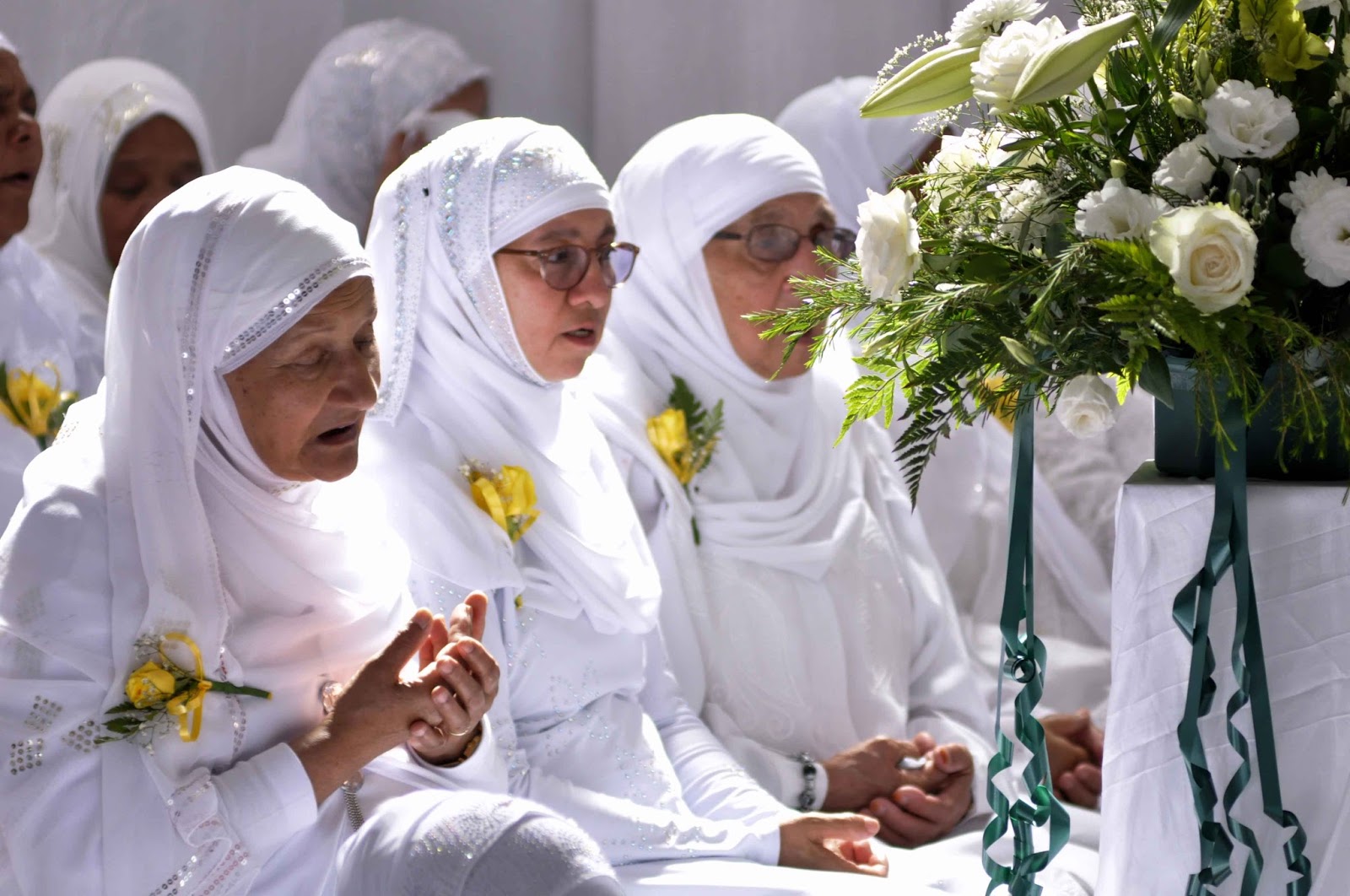
THE Ad-Dairat us-Salihiyyah Dhikr Circle celebrated the birth of the Prophet Muhammad at the Jami'at us-Sabr mosque in Primrose Park, Cape Town. Riwayats (accounts) of the Prophet's life were recited, as well as the well-known litany, the Ratib ul-Haddad. The gathering was led by by Hajjah Naiema Manie, who conducts weekly gatherings with the group at various venues around Cape Town.

Guest speaker was the well-known Hafiz ul-Qur'an, Shaikh Sa'dullah Khan, who is the director of Islamia College. Reciting the Quranic verse "You have indeed in the Messenger of Allah an excellent example..." he went on to say that the Muslim character, as personified by the Prophet, had to show the qualities of ease and not difficulty, compassion and not harshness, love and not hatred, balance and not extremism, kindness and not harshness and, finally, a smiling face and not a frown.

"This was the way to live the legacy of the Prophet Muhammad (peace be upon him)," he said. 

Those who attended the mawlud - the celebration of the Prophet's birth - went home  laden with gifts - a specially baked cup-cake, food, literature and a rose.


Photos Copyright Shafiq Morton