Friday, February 26, 2016

A Drop of the Mercy Ocean


This very simple, but beautiful nasihah (piece of advice) was found written on an envelope I discovered in my files the other day. It is dated November 1997, the time when the great sage, Shaikh Naazim 'Adil al-Haqqani visited  Cape Town, South Africa.

"Beloveds....you cannot reach dunya (the material world), it will always run from you. Run after moula (Lordship) not dunya. Learn to know about your Creator, ask him [for the favours] look for the real diamond. Allah, the Almighty, said He was the Hidden Treasure, not dunya. Get to know Him, learn to ask Him from the skies reaching the Mercy Ocean. The dunya people can't find one drop in the Ocean. People in the dunya are angry. Remember, the very dirtiest level of existence is under the dunya. Tariqat (the spiritual way) calls people to reach Allah, the eternal servants of the Great Sultan...

Tuesday, February 16, 2016

Mandla Mandela becomes Muslim, and the victim of unbecoming phobia and racism


Mandela and Clarke. Benny Gool Photo.
LATE Saturday night (6 February) my Blackberry vibrated with urgency on my night table. Oh no, not another Zuma moment, I thought, in deference to the fact that the embattled Presidency – in the belief that bad news and political skulduggery can be diluted – now issues its press releases after deadline.  

Fortunately, Number One hadn’t decided to play musical ministers, devalue the rand again or throw another Cabinet crony under the bus. It was a WhatsApp message telling me that Mandla Mandela had become Muslim. What?! I did a double take. Mandla Mandela a Muslim!

I opened the message and saw grainy cell phone images of Madiba’s elegant grandson in a Cape Town mosque. He was with the Muslim Judicial Council’s Shaikh Ebrahim Gabriels, who’d apparently just married him to a stunning young lady called Rabia Clarke. According to reports, Mandla had embraced Islam in November last year at the hands of Shaikh Riyad Walls, imam of the Stegmann Road mosque in Claremont.

Indeed, it was a pleasant change from Nkandlagate or the Days of Our Guptas, but I did wonder at the time how Mandela’s leap of faith would be interpreted and understood, not only in the Muslim community, but by all South Africans.

Another public figure, Justice John (now Yayha) Hlope had embraced Islam in April last year and married another judge, Gayaat Salie Samuels. Since then, the Hlopes had enjoyed a relatively low – and dignified – domestic profile after an initial blaze of publicity.

However, if you’re a Mandela – a Tembu chief and the grandson and nominal heir of the mighty Madiba – your DNA guarantees you media curiosity, paparazzi interest and gossip, especially if you’ve had “women” and other “troubles”.

These “troubles” have ranged from being accused of selling the media rights of Madiba’s funeral to reburying, without family permission, the remains of his three children. This caused a family rift, resulting in a court order for their bodies to be taken from Mvezo back to Qunu. It was believed that Mandla had moved the bodies in an attempt to cash in when his grandfather passed on.

If that was not enough, Mandla Mandela had had to face two charges of alleged road rage involving Amanda Liwani in 2012 and Mthatha schoolmaster, Mlamli Ngudle, in 2013. It is perhaps significant that these events coincided with a cuckolding and the consuming fury of an aggrieved, estranged first wife, whom he’d married in a civic ceremony in 2004.

A second, customary wedding to a 19 year-old from Reunion, Anais Grimaud (Nkosikazi Nobubele) in 2010, saw the increasing wrath of Tando Mabunu, his first wife, whose ire must have peaked when he took a third spouse, the Swazi princess Nodiyala Makathini, in 2011.

Inflamed by the fact he’d entered into customary marriages – and seeing a legal conflict between customary and civil matrimony in community of property – she sued for bigamy and won her case, attaching his cattle and suing for half his income on other charges of an alleged failure to pay maintenance.

To add to his woes, Mandla was to discover that his son, Qheya – named by Madiba himself – was not his, but the outcome of adultery by his own brother with Grimaud, who was sent packing to her mid Atlantic home.

Islam is not a confessional creed; to become Muslim is to earn absolution from the past. But Mandla Mandela, a very public figure, had to enter the faith with his personal baggage in full view. However, what he ultimately did belongs to his soul; it is between him and his Creator. And on that no one – absolutely no one – has the right to judge him.   

But Mandla Mandela – whom I’ve heard is happily reconciled to his identity anyway – has since been the victim of some unbecoming phobia and blatant racism, which is unfortunate given the tinder-box status of racism in the country right now.

I first got to hear about this at the State of the Nation Address (from where I was broadcasting with Voice of the Cape) when our reporters came back saying that members of the crowd had booed Mandla on the red carpet.  He was with Makathini, and so I wasn’t sure whether he’d been catcalled for not having his recent wife with him, or because he’d become a Muslim.

Earlier, the Congress of Traditional Leaders of South Africa (CONTRALESA) had indicated that a Muslim could not be a clan chief. Xolile Ndevu had told the media there was a “problem” with his “Islam”. I’ve heard that CONTRALESA – who were acting unconstitutionally – did later recant, but the damage had been done: the suggestion that a Muslim man could never be an acceptable leader in traditional circles.

With Mandla this was a touch ironic, I thought. The late Hasan Ghila, who’d embraced Islam in Cape Town in the 1950s, had told me that he’d heard the adhan, the call to prayer, whilst a child in the hills of the Transkei. It was an amazing spiritual experience, he’d said, and he’d depicted it as the call of his ancestors.

I’m certainly not ascribing group superiority in any way; the point is that the primordial nature, even some ancient customs of the isiXhosa, are essentially Abrahamic. The fact that it is African is what – inexplicably – leads to a feeling of shame when the opposite should be true.


Thursday, February 11, 2016

District Six - 50 years on...

FIFTY years ago the South African apartheid government tore out the soul of Cape Town when District Six, a multi-cultural and diverse racial community, found itself being declared a "white group area". On the slopes of Devil's Peak, and but a stone's throw from the city centre, some 60,000 people were homeless at the stroke of a bureaucrat's pen.

Too soon, the bulldozers moved in and people were forced to move to the sandy ghettoes of the Cape Flats as the old Victorian facades and cobbled streets tumbled into dust. The Cape Flats were more than 20 kms from the city and were a barren, windy wasteland. The salient question is whether the community has ever recovered, so psychologically devastating is forced removal and the loss of a home. Old people died from the grief and the stress of having to move from the place of their birth.

District Six is a memory for all those who've lost their homes, wherever they may be. The few buildings not destroyed were the churches and mosques, ghostly symbols clinging to the slopes of the mountain. The following is my journey through District Six's landscape and its few surviving pockets of humanity.


All Photos Copyright Shafiq Morton


Thursday, January 21, 2016

Racism in South Africa: a victim of two “isms”, colonialism and republican nationalism

Photo Copyright Shafiq Morton

In the light of racist utterances in social media we cannot lose focus now due to the distractions of the uninformed and the ignorant


RACISM – as defined by the UN in 1966 – is discrimination against another person on the basis of their race, or an event that reduces human dignity through actions based on skin colour. 

However, fully understanding the width and the breadth of racism in a few simple words is difficult. Racism is often a paradox: it’s a subtle, yet sometimes unsubtle, socially engineered prejudice.

There are also additional layers to racism: cultural, tribal, religious, nationalistic, linguistic and even socio-economic. And because racism is at times tacit, it’s not always a provable science.

In the light of recent overtly racist utterances in South Africa – chiefly on Facebook and Twitter – the question of racism, and even the legal policing of hate speech, has dominated the social media discourse.

It might be 22 years since the advent of political democracy and the wand of Nelson Mandela, but the hard reality is that over 300 years of colonialism and four decades of apartheid can’t simply be wished away, or airbrushed out of our collective psyche.

We South Africans – a self-critical nation of frequent laughter, forgiveness and generosity – are also a post-traumatic society given to violence, anger and xenophobia. Whilst not rushing to blame all our ills on apartheid, the scars do run deep.

The issue arose when Penny Sparrow, an estate agent from KwaZulu Natal, posted on Facebook that blacks, who visit our beaches in numbers over the festive season, were like “monkeys”. Her rider that “thoughtful” blacks weren’t simian just made her words even more repugnant.

It was a definite “gulp” moment. Sparrow’s post was typical of 19th century jingoism, her comments showing she was hopelessly clueless as to why the beaches were crowded in the first place.

The traditional Boxing Day beach bash – which occurs throughout the country – has become an expression of social entitlement. It has come to represent the celebration of spaces once denied to the poor by apartheid. These are mostly people who can only afford to hit the beaches once a year.

But, as it turned out, we rudely discovered that social media racism wasn’t just confined to whites only. Velaphi Khumalo, a civil servant from Limpopo, posted remarks about white South Africans being racist (even if they identified with the ruling ANC) and that they should be given the same treatment as the Jews under Hitler.

Hundreds of impassioned and eloquent column inches have since been written about all of this, but too little – I feel – has been said about the context, about racism historically so that we can begin to understand the Penny Sparrows and the Velaphi Khumalos of this world.

South Africa, to state the obvious, is a work in progress. And to understand non-racism – as evinced constitutionally – we have to fully examine its opposite.

What are racism’s roots? Theologists, particularly Muslim ones, argue that the Devil, formerly a jinn, was the first racist. Made of smokeless fire and thinking his nature was superior, he refused to bow to Adam symbolically shaped from the multi-coloured soils of the earth.

From a scriptural perspective in Genesis, it said by some that an incorrect attribution to the “curse of Ham”, Noah’s son, was used by early European explorers to justify the “otherisation” of non-Europeans.  

Others believe institutionalised racism reared a head when mediaeval Europe first came into contact with Africa, Asia and the Americas. Prompted by notions of cultural superiority and heathen-hood, nations were enslaved in the name of God and country.

Whilst much of contemporary racism can be traced back to the consequences of latter day colonialism, it does not quite present the full picture as there are lots of grey areas. This is because Africa, Asia and the Americas had met Europe long before Europe had met them.

Space precludes me listing all the examples, but Mansa Musa of 14th century Mali – possibly the richest ruler of all time – had white slaves in his huge entourage, as did the black Pharaohs thousands of years ago.  

In fact, the Islamic world at its nadir didn't even regard Europe as significant. When Baghdad had hundreds of thousands of books in its libraries, most of Europe's nobility – as historian Philip Hitti says – could not even write their names.

So how do we then understand racism in our South African context?

I would say that we have suffered from two kinds of institutionalised racism, the first being colonialism – for us the Portuguese, the Dutch and then the English. Here a key figure is Cecil John Rhodes, a mining magnate and bankist who not only believed in the superiority of the English, but who had a vision of British domination from Cape to Cairo.

The masonic structure on Devil’s Peak in Cape Town is a monument to Rhodes’ imperial vision – ironically, it is more overtly “racist” than his statues at UCT or Oxford.

Rhodes was at the helm of the Cape colony in 1899 when the Boer War broke out. The Afrikaners, frustrated by British domination, were republican nationalists in the Transvaal fighting British imperialism and its greed for Witwatersrand gold.

So Afrikanerdom was never a colonialist ideal, in spite of the later annexation of Namibia and the machinations of Cold War leaders in Angola and Mozambique (apartheid was seen as a bulwark against communism). In essence, then, South Africa has been the victim of two race-isms: colonialism and republican nationalism.

In other words, the Sparrows hail from the imperial consciousness of European colonialism and the high forts of Afrikanerdom; the Khumalos hail from the broken kingdoms of the Nguni and the despoiled pastures and plains of the Khoi and the San.

In South Africa, the challenge is the merger of these opposites, the subjugator and the subjugated into a genuine rights culture – a culture where historical imbalances are corrected and each group is part of a united whole. Nobody ever said it would be easy, but in 1994 we did make a start.  

The point is: we cannot lose focus now due to the distractions of the uninformed and the ignorant. Let the racists wither on the bough of social disapproval, we have work to do.

Tuesday, January 19, 2016

District Six Commemoration of Prophet


THE Salihiyyah male jama'at, or congregation, held their annual mawlud - the celebration of the Prophet's birthday - at the Khalil-ur-Rahman mosque in District Six in conjunction with the Ad-Dairat Dhikr Circle. The gathering was addressed by Maulana Abdurahman Khan, who'd just returned from Tarim in Hadramaut where he'd visited his teacher, Habib 'Umar ibn Hafidh.

Commenting on the devotional litany of the Ratib ul-Haddad read during the ceremony (and which had been penned by the famous 17th century saint of Hadramaut, Imam 'Abdullah al-Haddad) Mla Khan said that he'd visited the grave of the the Imam, and made invocations that those who made the Ratib in Cape Town would be blessed by its many benefits. 

He also said that if the Qur'an approved of the births of Yahya (John the Baptist) and 'Isa (Jesus) then how much more would the Creator smile upon those celebrating the birth of Muhammad, the most praised one, in a beautiful and permitted way.

The gathering was graced by the Hudam qasidah group, whose world-class nasheed (or devotional recitation of poetry) captivated those present.


Photos Copyright Shafiq Morton


Monday, January 11, 2016

Cape Town women celebrate birth of the Prophet


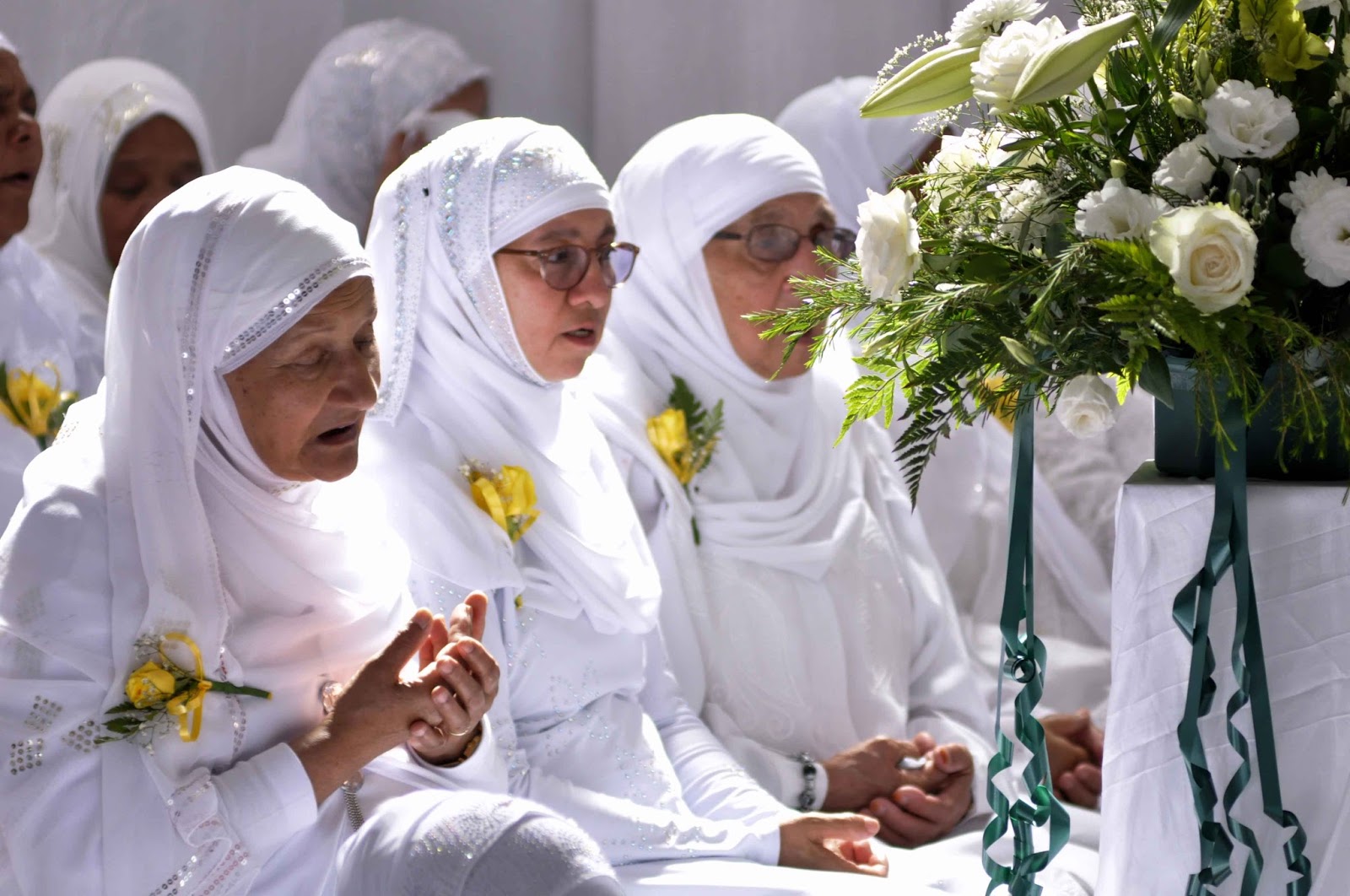
THE Ad-Dairat us-Salihiyyah Dhikr Circle celebrated the birth of the Prophet Muhammad at the Jami'at us-Sabr mosque in Primrose Park, Cape Town. Riwayats (accounts) of the Prophet's life were recited, as well as the well-known litany, the Ratib ul-Haddad. The gathering was led by by Hajjah Naiema Manie, who conducts weekly gatherings with the group at various venues around Cape Town.

Guest speaker was the well-known Hafiz ul-Qur'an, Shaikh Sa'dullah Khan, who is the director of Islamia College. Reciting the Quranic verse "You have indeed in the Messenger of Allah an excellent example..." he went on to say that the Muslim character, as personified by the Prophet, had to show the qualities of ease and not difficulty, compassion and not harshness, love and not hatred, balance and not extremism, kindness and not harshness and, finally, a smiling face and not a frown.

"This was the way to live the legacy of the Prophet Muhammad (peace be upon him)," he said. 

Those who attended the mawlud - the celebration of the Prophet's birth - went home  laden with gifts - a specially baked cup-cake, food, literature and a rose.


Photos Copyright Shafiq Morton