|
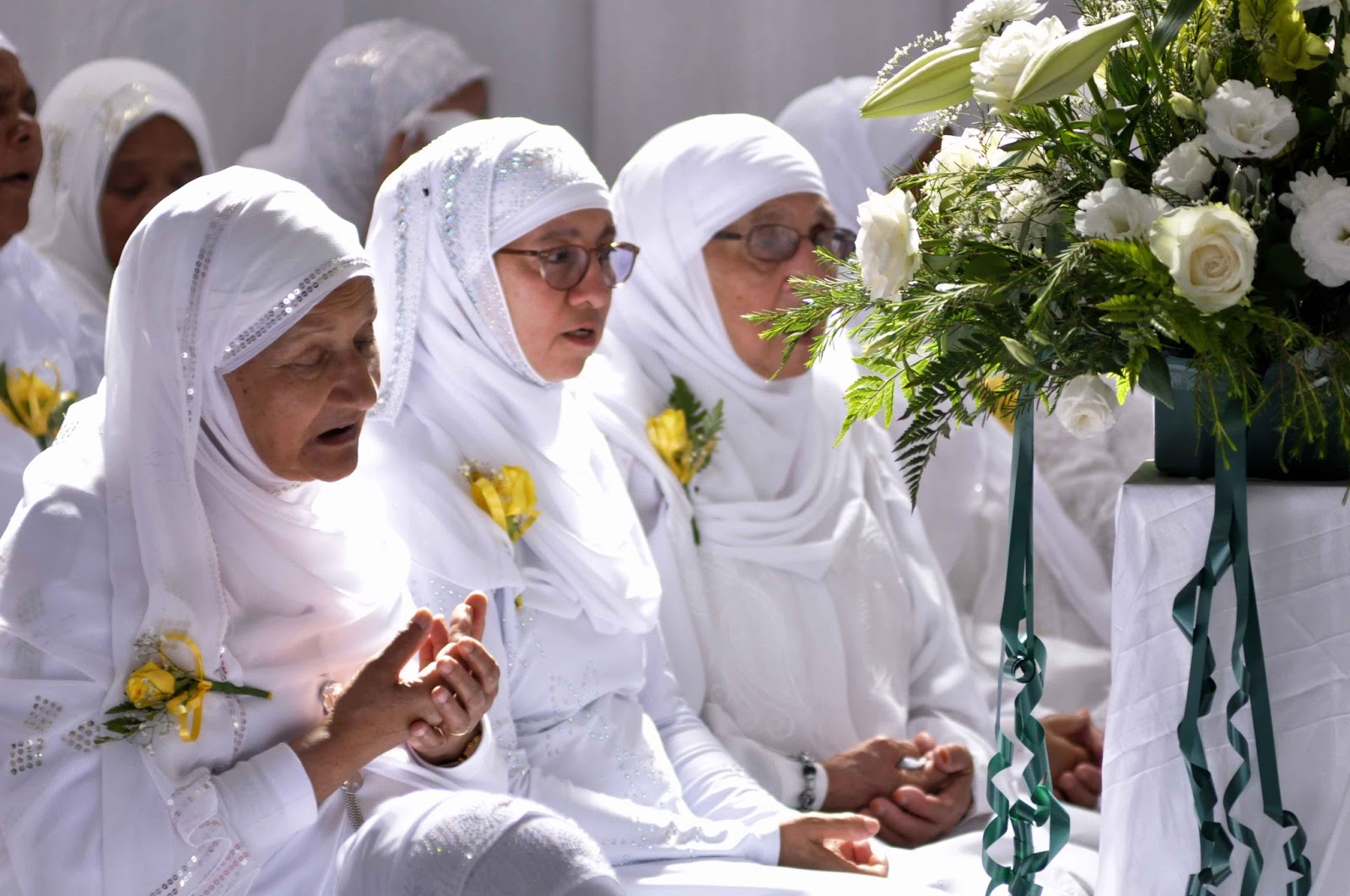
| Shaikh Ahmad Hendricks, Azzawia, Cape Town. |
THE MAWLUD-UN NABI, the celebration of the Prophet Muhammad’s
birth, was held in the Azzawia in Cape Town as it has been held for the past 90
years, with the recitation of the riwayats – or sections – of the famous 300
verse poem (The Jewelled Necklace of the Magnificent
Prophet) written by the Madinah scholar, Sayyid Ja’fr ibn Hasan ibn Abd ul-Karim
al-Barzanji, in the 18th century.
The Barzanjis are a famous line of Shafi’i scholars. They originally
hailed from the Kurdish areas of modern-day Iraq, and migrated to the Prophet’s
city of Madinah. The mawlūd was addressed by Shaikh Ahmad Hendricks, an imam at
the Azzawia and a khalifah – or representative – of the famous Hijazi scholar, the
late Sayyid Muhammad ‘Alawi al-Maliki.
Speaking in the Cape Town patois of Afrikaans and English,
the Shaikh referred to the special events surrounding the Prophet’s birth, such
as fourteen towers of Chosroes’ palace in Persia collapsing and the Zoroastrian
flame, nurtured for over 1,000 years, suddenly extinguishing itself.
He then alluded to the nur – or light – of the Prophet,
saying that at his birth it was recorded that there was a “light”. Of course, one had to realise that this light
was metaphorical, as much as it was literal – such as A’ishah finding a needle in the Prophet's chamber due to his spiritual effulgence.
The tradition, or Hadith, “…the first thing Allah created
was my light…” whilst regarded as weak by some scholars was, however,
substantiated by the Quran stating “We brought you a light (the Prophet) and a
Clear Book (the Quran)…”
Shaikh Ahmad, stressing the qualities of the Prophet and his
mercy, referred to the four women who’d suckled him: Aminah (his mother), Barakah
(the Abyssinian), Thuwaybah (the former slave of his uncle Abu Lahab) and
Halimah, his Bedouin wet-nurse who looked after him until he was five years of
age.
There was wisdom and guidance in all of this, especially relating
to the Prophet’s status and honour. Aminah had borne the essential Adamic light,
[its miracle apparent at Muhammad’s birth when she’d seen the towers of Syria].
Barakah, an African maidservant whom the prophet loved
dearly, had laid to rest any notions of race being superior. Halimah had witnessed
great blessing. Hailing from Hawazim, a poverty-stricken region, she’d travelled
to Makkah to find a child to suckle, which was a custom of the ancient urban Arabs.
They’d usually sent their infants into the desert with wet
nurses believing it would strengthen them. For many of the rural women,
suckling was a means of subsistence. But as Halimah arrived in Mecca, all the
babies had been taken. An orphan called Muhammad was her only, and less
profitable, option.
Yet the minute she adopted him her breasts had overflowed
with milk, her camel’s udders had filled and when she got home, her livestock had
flourished and her crops had thrived. Also, during his stay in the desert, an
Angel had miraculously opened Muhammad’s chest, removed a black clot from his
heart, and infused it with wisdom and knowledge.
The Shaikh then mentioned that this was the “heart” of the
Deen, the subtle essence of Islam; no inherent wisdom would mean no ways to appreciate
knowledge [no inherent taqwa – or compassionate God-awareness – would mean no
recourse to the Divine].
Also, the Prophet’s orphanhood reflected inspired sagacity
in that he was not seen to have any familial agendas – no political conspiracy or
ulterior motives could be attached to him in a world of Meccan intrigue.
To get close to the Prophet, said the Shaikh, was to get
close to his mercy. It was evident that through Halima we’d been shown this. There
was great boon in the agency of the prophet and his family. The Meccans had
used the good name of the Prophet’s uncle, Ibn ‘Abbas, in their successful invocations
for a drought to be broken. The point is that through intimacy with the Prophet
comes growth and fertility.
However, notions that one could not celebrate the life, and
the birth, of the Prophet had to be dispelled, he said. The Prophet had fasted
on Mondays in celebration of his birthday. Thuwaybah, the slave-girl of the
Prophet’s uncle, Abu Lahab, was freed due to his joy at the birth of Muhammad.
And whilst Abu Lahab (the Father of the Flames)
had become one of his greatest enemies, Abu Lahab had appeared in a vision after
his death to one of his family members in a dishevelled and unhappy state.
In it Abu Lahab [reported in the authoritative Bukhari and related
by Urwah ibn al-Zubair]
had said that because he’d freed Thuwaybah in joy at the birth of his nephew,
every Monday (the day the Prophet was born) his sojourn in hell had been relieved
by being able to drink a little water dripping from his fingers.
More the point, suggested Shaikh Ahmad, if such a person as
Abu Lahab is so rewarded by Allah, what about the one spending his whole life
close to the blessed Prophet ?
In terms of being able to celebrate the Prophetic legacy on
a given day, the Shaikh referred to the fast of Ashurah or 10 Muharram, when
the Prophet had asked the Jews of Madinah why they’d fasted on this day. When told
it commemorated the day when God had freed Moses from the Pharaoh, the Prophet
had replied the Muslims had a right to Moses as well, and urged them to fast on
this specific day.
Finally, Shaikh Ahmad mentioned that the dictum “the Prophet
did not do it” had never been a principle in Islamic legislation. All jurists
agreed that not practising an action could never be appropriate evidence in law.
In other words, this could never be the juridicial basis for making anything haram,
or forbidden, as so many do.
When the Prophet did not practice something, a responsible
person had to embrace the gamut of possibilities surrounding the non-action. For
example, the Prophet not eating lizard himself, but not prohibiting it – or refraining
from the tarawīḥ prayer in the mosque during his lifetime because he feared it
would become obligatory. The lack of the
Prophet doing something could never be used as legal proof in Islam, he said.
__________________