Saturday, March 3, 2018
Monday, February 19, 2018
Cape Town’s water crisis: we are not alone
![]() |
| Photo Shafiq Morton |
THIS piece is not about the blame game, triggered by the ‘worst drought in living memory’. Nor is it about the arrogance and the rank incompetence of our city authorities, who only woke up when they realised that they would be the first administration in the world to run out of water.
No, this is not about the DA and its cloying attempts to shift the blame, and nor is it about the ANC, intent on scoring points against the DA. Locked into five-year election cycles that have ignored long term planning, our political parties have simply dropped the ball.
The point is; water affects every South African citizen. We are a water-stressed country, and water has to transcend party differences.
Today’s status quo – the city of Cape Town unilaterally installing water restriction devices that have never passed SABS or NRCS muster – is the equivalent of a chain store blaming its customers for its poor service, and then forcing them to purchase inferior goods as a result. It is no wonder that the public is angry.
Bureaucratically, Big Brother now fully controls our water, and we are now captive to the big business of water reticulation. Then there is the fact that plans to heighten dam walls, clean alien vegetation and maintain channels in the catchment areas were either never done, or simply neglected.
The great shame, the why of the water crisis, is that government and council have ignored a host of water experts – sometimes even their own – for decades. In fact, the first caution about water in the Western Cape was issued in 1970. The second warning, the result of research in 1990, said that we could run dry by 2007.
In 2005, a local company, Grahamtec, offered to install a R2 million desalination plant at the V & A Waterfront at its own expense to showcase the cost effectiveness of desalination. The city turned it down.
Since then, South African manufacturers have struggled to get local tenders, despite the fact that their plants have been installed internationally in places such as Dubai and Saudi Arabia, and successfully helped to wean Singapore off the Malaysian grid.
Then there has been the whiff of corruption: suspensions at the state owned Umgeni Water. Our own desalination plants re-labelled overseas and offered back to us at four times the price. Israeli desalination technology, copied from South Africa, being considered the cure all – from so-called water experts, who have exhausted the West Bank aquifer, pirated Syrian water from the occupied Golan Heights, nearly drained the Dead Sea – and who have covered the land with alien, water guzzling pines.
But back to the why of the water crisis. In 2007, water researchers issued another warning; this time saying that if current demand continued, Cape Town would run dry by 2012-15. Michael Muller of the SA Water Institute reported that the council was ‘arrogant and over confident’, saying that our water would last until 2022.
To its credit, the city did institute some measures of saving. But as we all know, that was not enough to get through our latest drought cycle – which began in 2015, largely due to the El Nino phenomenon, a change in the surface temperature of the Pacific.
The earth’s ocean currents and weather systems are all inter-linked, and El Nino – or its effeminate twin La Nina – shifts the trajectory of frontal systems, causing droughts in some regions and flooding in others.
For countries such as Australia, Brazil, India, Spain, South Africa and the US, the complex El Nino/La Nina effect has meant drought. For other regions of Asia and the Caribbean, it has meant torrential rainfall and high-strength cyclones.
The harsh reality is that parts of Asia, the Americas, Australia and Africa are all severely water-stressed. In Brazil, over 800 metropolitan areas have become water-stressed; Perth and Melbourne in Australia face similar challenges, and Barcelona – not unlike Cape Town – went to the brink.
This is all happening on a planet – which is covered 70% by water – but where only three per cent is potable, and of that, another 50% is locked up in glaciers.
As a surfer who has monitored the weather keenly for five decades, and who as a radio presenter has done a daily weather report for 20 years, I can safely say that our climate is slowly changing over the long term.
Whilst our cycles of dry and wet years have more or less remained consistent within the limited bands of predictability, there have been shifts. For example, kelp – a cold-water organism – has encroached further into False Bay due to fewer westerly winds, which warm the sea after the cold upwelling of the southeaster.
Our weather systems – admixed with the side effects of global warming – often result in more extreme frontal incidences, such as the Peninsula’s near-cyclone of June last year and the hurricanes of the Gulf.
However, at the end of the day, water crises are rarely a matter of rainfall, but more a case of bad human management. In this, we are certainly not alone. For us to survive, there is a need for a more a more holistic understanding, and environmentally sensitive approach, to water catchment. People should not be punished, as in Cape Town, for going off the grid.
However, whatever happens, our precious water resources must not fall into the hands of greedy privateers, which occurred in California. It is the duty of the state to provide water for us all – without discriminating against the poor, for whom the bucket queues of Day Zero are already a daily occurrence.
An edited version was first published in Muslim Views.
Wednesday, December 20, 2017
Prophet is remembered in Cape Town
![]() |
| Time for reflection. Mawlud 2017. |
THE Ad Dai'rut us-Salihiyya Dhikr Circle, led by Hajjah Naema Manie, held their annual mawlud - the commemoration of the Prophet's birth - at the Ahmedi mosque in Victoria Rd, Grassy Park, Cape Town.
The packed mosque was addressed by Shaykh Ziyad Fatar and Shaykh Muhammad Allie Khalfe, who both spoke about the noble aspects of the Prophet Muhammad and his life, which was one of clemency, mercy and respect for all. The riwayats - verses - of the famous Barzanji poem on the life of the Prophet were recited in the unique, melodious Cape Town style.
![]() |
| Hajjah Naema hands out roses, a sign of love. |
![]() |
| The mosque was filled to capacity. |
![]() |
| Yellow roses were favoured by the Prophet. |
![]() |
| The elderly enjoy the occasion. |
![]() |
| Commemorating the Prophet [saw]. |
![]() |
| Sh Ziyad Fatar. |
![]() |
| The rows. |
![]() |
| Hajjah Naema leads the recitation. |
![]() |
| Du'ah. |
![]() |
| Sh Allie Khalfe. |
![]() |
| Hajjah Naema. |
![]() |
| Mustafa Atef from Egypt dazzled with his poetic voice. |
![]() |
| A packed auditorium is reflected on the screen. |
![]() |
| Reciting the Barzanji at Century City. |
![]() |
| The Group presents Shaykh Ninowy with a specially baked cake. |
![]() |
| Sh Ninowy addresses the crowd. |
![]() |
| Contemplation. |
Monday, November 27, 2017
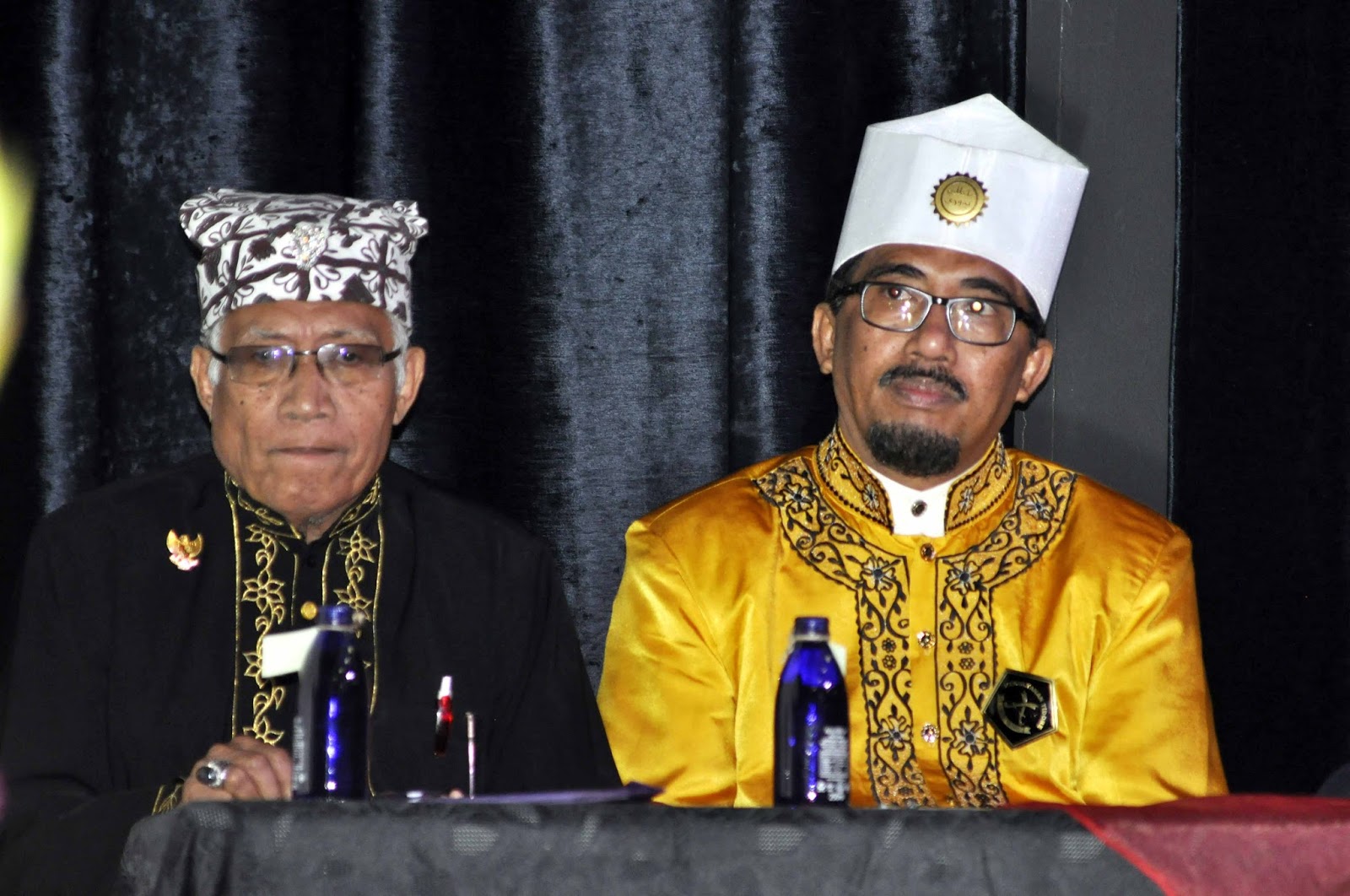
Historic visit to the Cape by Tuan Guru descendant
![]() |
| Sekretaris Muhammad Amin Faruq is re-united with his Tidorean ancestor after 127 years. © Shafiq Morton |
HISTORY
was made in the Cape this past month when a direct descendant of Imam ‘Abdullah
ibn Qadi Abdus Salam (Tuan Guru), Sekretaris Muhammad Amin Faruq, toured the
city together with the Sultan of Tidore, His Excellency Jo Hussain Abu Bakr
Shah.
This
was the first time that a delegation from Tuan Guru’s birthplace had ever
visited the country. Sekretaris Faruq describes himself as the fifth generation
from Sha’an Yughni, Tuan Guru’s third eldest son (of eleven), who was left
behind in Tidore in 1779 when the Dutch exiled Tuan Guru to the Cape for
political resistance.
Hosted
by the Rakiep family, the delegation visited the Castle, the Slave lodge, the
Awwal mosque, the Bo Kaap museum and parliament, amidst family functions and a symposium
held at Islamia College. At parliament, the visitors were received by Minister
of Economic Development, Ebrahim Patel, himself a descendent of Tuan Guru.
The
historic visit was the culmination of decades of passionate, but largely
unacknowledged research by the late Hajji Nur Erefaan Rakiep in locating Tuan
Guru’s family in the eastern archipelago, and establishing his own family heritage.
According
to Sekretaris Faruq, Tuan Guru is the grandson of Habib ‘Umar Rahmat al-Faruq,
who left Cirebon in northwest Java in the 17th century for Tidore.
It has been established that Habib Faruq was a descendent of Sunan Gunung Jati,
or Sharif Hidayutallah, one of the Wali Songo, or nine founding saints of Java.
An
examination of the family chains, though sometimes broken, do reveal that Tuan
Guru (via Sharif Hidayutallah) could have been a Hussaini Sayyid, from the line
of Zain ul-‘Abidin to ‘Ali al-‘Uraidhi from Imam Ahmad al-Muhajir, who trekked
to the Hadhramaut in about 820 CE from Basra in Iraq.
It is
believed that the offspring of Sayyid ‘Alawi bin ‘Ubaidallah, descended from
the house of Imam Ahmad Muhajir, travelled
to the Far East, Pakistan and India. Sharif Hidayutallah (died circa 1558 CE) traces
his lineage through Sayyid ‘Abdullah Azmat Khan of India.
There are no links of
Tuan Guru to Morocco, which has been the result of a confused transcription of “Molluca”
or “Maluku”, the sea bordering Tidore.
The
climax of the tour occurred on a baking hot morning, 30 October, when the
Sultan and Sekretaris Faruq visited the grave of their long lost island
ancestor, for the first time, at the Tana Baru above the Bo Kaap. It proved to
be a deeply moving, and poignant, reunion with many tears.
In an
interview at the grave, Sekretaris Faruq said that the visit of the Tidoreans
had been a historic moment, as for years, nobody had known where Tuan Guru was.
He said it was interesting that Tuan Guru had been honoured as “Mister Teacher”
in the Cape, as in Tidore he had been given the honorific title “Jo Guru”,
almost the same equivalent, before his exile.
The
Sultan of Tidore said that his visit had been inspiring. He said that when he
returned home he would seek an appointment with the President of Indonesia, Joko
Widodo, to get Tuan Guru declared a national hero in the same way that Shaykh
Yusuf of Makasar and Prince Nuku – who’d both resisted the Dutch – had been
honoured.
Shafiq Morton is currently
researching a book on Tuan Guru entitled “The Life and Times of Tuan Guru”
under the aegis of Awqaf SA.
![]() |
| His Excellency Jo Hussain Abu Bakr Shah (right) wearing the ceremonial yellow of the Tidorean sultanate. |
When even the devil is ashamed: the ‘mufti-universe’ of sectarianism and the admonitions of Sinai
THERE is a
story that the devil sits on a throne, and that each day all the demons report
back to him. The reward for the one who has perpetrated the worst possible
deeds on earth, gets a chance to sit on the devil’s throne and to boast. And because
the devil’s court is a house of naked envy, all the other demons get jealous,
and want to destroy the one on the throne.
So when the devil
takes back his seat, the ‘victorious’ evil spirit finds itself thrown to the
dogs of malice. The braggart that had previously enjoyed a few moments of
notoriety – which he sees as fame – is soon set upon like a pack of hyenas, and
forgotten.
A Sufi Shaykh,
who passed on a few years ago, once said times had got so bad that even the
devil himself was beginning to feel ashamed. A man of wit, even until the end,
there is a definite barb in what the Shaykh said, as atrocity follows atrocity.
In our
community, I have begun to wonder recently whether our own devil wears not
Prada, but the self-imposed title of a ‘mufti’. Harsh, yes. But in a world of
isms, especially sectarianism, anonymous local cyber gangsters – supporting a swarm of these ‘muftis’ – have been pouring hate, vitriol, and specifically polytheism
and kufr, on a recently built Shi’ah mosque in Cape Town.
Poor people are
rooting in the dustbins outside their palatial homes, their brothers and
sisters are crying for help in the townships, the youth are asking questions –
and yet, these ‘muftis’ (there seem to be no women in their ranks) – blithely condemn
others on a manner of issues, and even regard them as a threat to their faith.
There are some serious questions here: firstly, if someone else’s beliefs are threat to yours, have you not considered that they might not be threat to mine?
Secondly, in
traditional Islam, classical Ahlus Sunni Islam a mufti is an honoured position
bestowed upon a learned elder by other learned elders, usually in the area of
Usul ul-Fiqh, the understanding and application of Shari’ah. In classical Ahlus
Sunni Islam, a mufti is a solitary title given to the most senior, experienced
jurist in a city, or a country. It is, therefore, surreal that we should have so
many ‘muftis’ in South Africa.
Thirdly, there
is the irresponsible abandon with which things are declared forbidden in this ‘mufti
universe’, this done without adequate legal argument, maslahah (the concept of social benefit) or consideration of valid opposing
views – all pre-requisites of fiqh.
In addition. the
willingness to indulge in takfir – in our case a blanket declaration of
unbelief on others one disagrees with creedally, or even politically – is another symptom of the ‘mufti’ disease, and
contrary to the tolerant spirit of the Ahlus Sunnah. And in case ‘tolerance’ is
seen as a weakness, Sayyidina ‘Ali – the fourth Caliph – once threw an orator out of the mosque when
he failed the tests of a scholar.
On the question
of takfir, all the Righteous Caliphs, Sayyidina Abu Bakr, Sayyidina ‘Umar, Sayyidina
‘Uthman and Sayyidina ‘Ali were always very reluctant to declare unbelief. This
tradition was carried on by the famous legal imams, Imam Malik, Abu Hanifah,
Imam Shafi’i and Imam Hanbal, as well as Ja’fr al-Sadiq.
Consequently, the
obsession by some to declare a newly constructed Shi’ah mosque a ‘temple’ and a
‘house of kufr’ is a case of blind intolerance. It is, tragically, symptomatic
of the sectarian culture of takfir, which has so bedevilled the Muslim
community in recent decades – and in no small measure, is thanks to the house
of Sa’ud and the dangerously reductionist notions of Ibn ‘Abd ul-Wahhab.
Yes, Sunni and
Shi’ah do enjoy differences; some present testing academic questions. Unfortunately,
space does not allow for anything more than an acknowledgment of this, but we
are not trivialising things. What is more important here is to consider the
adab ul-ikhtilaf, the honourable manner of dealing with difference – recommended
by all scholars, via the example of the Prophet.
The point is
that traditional Ahlus Sunnah scholars, whilst expressing their academic concerns
about Shi’ism, have never declared the Shi’ah as polytheists or kafirs, and for
over 1,400 years have allowed them to perform the Hajj cheek-by-jowl with
Sunnis.
Historically,
scholars of the Al-Azhar – such as Shaykh Shaltut of the pre Sisi era – have regarded
Shi’ism as another ‘madh-hab’, or school of thought. Anyone who is
uncomfortable with this, is free to contest it with the tools of Islamic
discourse.
In countries
such as Iraq, Syria, Pakistan, India, Afghanistan and Yemen, Shi’ah lived peacefully
with Sunnis for centuries until the dark clouds of 20th century sectarianism –
introduced by the takfiri psychosis of Al-Qaeda, the Taliban and Da’esh – gathered
on our horizon. And dwelling on, or bemoaning, Zionist-western backed conspiracies
serves no purpose, because we are the people who have to deal with the curse of
takfiri sectarianism.
As we know, its
worst excesses have manifested themselves in Syria, Iraq and various eastern
and western capitals at the hands of Da’esh. The recent Sinai massacre,
shocking in its execution and brutally inhumane in its bilious justification, is
but the most recent example of the bloodthirsty spleen of preaching hate and
takfir in the name of God.
Our local ‘muftis’
and their anonymous acolytes – pouring petrol on the local Shi’ah community whilst
waving a match – need to understand the consequences of their inflammatory and thoroughly
seditious behaviour. The
Sinai massacre, after all, is the tragic end-game of takfir – and if we don’t
heed the warning now, we are all doomed.
Thursday, October 19, 2017
The story of the two Sarahs – Saartjie Baartman and Saartjie van de Kaap
I HAVE been researching a book on Tuan Guru, Imam
‘Abdullah ibn Qadi ‘Abdus Salam of Tidore, one of our iconic historical figures
at the Cape. What has emerged, so far, is that what we know is fragmentary, and
that we have absolutely no details of his life before his exile to the Cape in
1780.
Despite
this, a personality does emerge. It is evident that Tuan Guru – who described
himself as ‘mazlum’ (the oppressed one) – was feisty enough to defy the Statute
of India to hold the first jumu’ah (Friday prayers) in the Chiappini Street
quarry, and to be a pioneer of education via the establishment of his madrasah (school)
in 1793, five years before the founding of the Awwal mosque, the first in South Africa.
In searching
for Tuan Guru, other characters such as Tuan Sayyid Alawi, Achmat van Bengal
from Chinsura, Jan van Boughies of Long Street and Paay Schaapie – the kindly dervish
with a calabash on his head – emerge from the shadows.
Profound
in this journey is just exactly how colonialism has marginalised the narrative
of those not writing it. Archivally, it is often just a throwaway line, a quick
derisory mention by a colonial official – or as in the instance of the Awwal
masjid, a court case – that gives us the leads.
Being
of their times, the accounts are also patriarchal. Women are rarely mentioned,
and if they are, it’s fleetingly. The Slave lodge, a house of many horrors,
became a glorified brothel and records show that not one person was ever
convicted for the rape of a slave woman at the Cape.
So it
is supremely ironic that I find two women – both Sarah, but called the Dutch
diminutive ‘Saartjie’ – who play such a crucial, but disparate, role in our
early history. Both lived at almost the same time, but their lives could not
have been more different.
Saartjie
van de Kaap is the daughter of Trijn van de Kaap, who married a manumitted
slave, Coridon of Ceylon, a landowner. Trijn is most likely a compaction of
‘Katerina’. Despite not knowing her original name, we do know – via the archives
– that after the death of her husband in 1797, Trijn owned four slaves and
rented out property.
What’s
noteworthy is that Trijn, and not a male family member, inherited Coridon’s
landed estate. This indicates that Coridon (and Trijn) must have had knowledge
of Islamic law allowing Muslim women – despite the paternalism of the era – to
own property.
In her
household was Ahmad van Bengal (registered as Job van Bengalen), and Tuan
Guru’s most trusted associate, who had married her daughter, Saartjie. It was
while the property was owned by Trijn that the Awwal mosque was established in
1798.
It is
in her will of 1841 that we see her character. After Ahmad van Bengal passed on
in 1843, and with the Muslim community beginning to fragment, she had the
foresight – and courage – to request Imam Abdol Barrie (as opposed to one of
her three sons) to be the imam at her funeral.
She
appointed an independent advocate as the executor of her will, instead of her
sons Mochamat, Hamiem and Saddik, who were – to her great hurt – planning the
establishment of the Nurul Islam mosque.
In
addition, her will stated that the property at 28 Dorp Street be used as a
mosque by her descendants for as long as Islam remained at the Colony, and that
conditional to this was that the property of the mosque never be sold, or
mortgaged.
Indeed,
not only was the first mosque in South Africa initially owned by a woman, Trijn
van de Kaap, but also the first waqf in South Africa was decreed by her
daughter, Saartjie van de Kaap.
From
the triumphs of Saartjie van de Kaap we go to the trials of Saartjie Baartman,
the most tragic symbol of the colonial era, and a victim of the grossest scientific
racism in modern times. Born in the Gamtoos River area, and from the Gonaquasub clan, she allegedly ‘signed’ a
contract with an English ship surgeon, William Dunlop, to go to England.
Baartman’s
large buttocks and enlarged pudenda made her the object of fascination by the
colonial Europeans, who presumed that they were racially superior and that ‘negroid’
peoples were primitive and over-sexed like animals.
She
was paraded in a cage like a circus animal, her vital parts covered by a cloth.
Sadly, after her death in 1815 – due to a combination of alcoholism, syphilis, possibly
pneumonia or smallpox and even heartbreak – two Khoi-San would be taken to
Germany in the same manner in 1845, with two more being shown as ‘Bosjemans’ in
a travelling circus in 1846.
Baartman
attracted the attention of George Cuvier, a naturalist, who asked if she could
be studied as a science specimen, when she was sold in France to an animal
trainer. From March 1815 until her untimely death, Saartjie Baartman was prodded
and studied by French anatomists, zoologists and physiologists.
Cuvier
concluded that the young Gonaquasub woman was a link between apes and humans. Interestingly,
Cuvier observes that Saartjie Baartman was actually an intelligent woman, with
an excellent memory – especially faces. She spoke Khoi, Dutch, passable English
and a smattering of French, and had a lively personality.
Cuvier
even mentions that her shoulders and back were ‘graceful’, that her arms were ‘slender’,
and that her hands and feet were ‘charming’ and ‘pretty’, yet – sadly – he is
unable to break from the acculturated shackles of his racism, or even
comprehend his grotesque contradictions.
In
every way, I would suggest that Saartjie Baartman and Saartjie van de Kaap are kindred
sisters, spirits of our unrecognised history – one an icon, one a pioneer. It
is said that no one chooses their destiny, but in the contrasts – and in the victories
and in the supreme tests of their lives as women – we find meaning in what they
represent that resonates even in today’s South Africa, from the wretched to the
sublime.
Tuesday, July 11, 2017
The inquest of Ahmed Timol's death in detention, seeking the final truth
THE re-opening
of the inquest into the causes of Ahmed Timol’s death in detention, 45 years
after the fact, is most certainly a long-awaited constitutional triumph.
However, with it comes tremendous pain, and the nightmares of an era when
security policemen were licensed killers.
For
me, it is a distressing story to write – as like so many – these shadowy men were
once an integral, and unpleasant, part of my life. I was one of the lucky ones,
though, escaping a certain Lieutenant Frans Mostert. He’d arrived at Lavender
Hill High School, where I taught then, early one November morning in 1985.
Accompanied
by three cars, a mustard coloured Colt Gallant, a box Toyota Corolla and a red
vehicle (whose make I can’t recall), Mostert’s story to the principal that he
just wanted to ask me “a few questions” was not convincing. I was warned and
managed to avoid the reception committee.
This happened
after the Security Police had been tailing us for some time, even detaining one
of our comrades and beating him up at Maitland Police station. His “crime”? He couldn’t
name a “blonde lady” in the group. In those days I had long hair and the “blond
lady” was actually me. I was only identified later, and as an extremely minor
activist, it seemed as if my time had come.
I had
a narrow escape from Mostert, but I still had to go underground. In those days
you were guilty by association, and I was privy to the location of some buried AK47s
that would not only have incriminated me, but others too.
Mostert
had somehow got wind of this, and he’d become like a rabid dog. My fear of
being detained, like everyone else, was real. By 1985 nearly 60 people had died
in detention and we knew what the torturers were doing – especially at
Culemborg, a disused shunting yard in Cape Town’s CBD.
Last
week, mindful of the Timol inquest and the invitation to do a story, I put up a
post on Facebook and re-visited the TRC files. After a few harrowing hours of
going through testimonies, I grew angry. Very angry. I’d been reminded, again,
of how few of these demented men had pitched up at the TRC.
The
Facebook string was even more illuminating. We’ve really forgotten how many
people were touched by the State of Emergency. The list of security Branch psychopaths
increased with every post. This struggle narrative, the one of the
rank-and-file, is one that must be told.
And even
for those high-profile victims – like Imam Abdullah Haron, Suliman Salojee,
Steve Biko, Dr Hoosen Haffajee, Dr Neil Aggett and Ahmed Timol – there are also
stories that still need to be told.
So
when Judge Billy Mothle of the Gauteng High Court ordered that all the
surviving policemen (three out of 23) who were involved in the detention of activists
Salim Essop and Ahmed Timol, be subpoenaed to testify, I cheered.
For John
Vorster Square is not only responsible for the death of Timol, but six other
activists too: Wellington Tshazibane, Mathews Mabelane, Samuel Malinga, Dr Neil
Aggett, Ernest Dipale and Clayton Sithole.
The inquest
– this time a proper one in response to findings and representations to the NPA
by the Timol family – sits again later this month to further investigate claims
that the police lied to mask the truth of Timol’s brutal killing in 1971.
Magistrate
JL De Villiers, who sat on the enquiry, has been accused of ignoring key
forensic findings in exonerating the police – who bizarrely claimed Timol, a
teacher and member of the SA Communist Party, had jumped out a 10th story window.
It
will be interesting to hear what these men have to say, almost half a century
later, about the killing of Timol and the torture of Essop and so many others
in a vault – called Die Waarkamer (the Truth Room) – in Room 1013.
“I
will authorise the issue of subpoenas to all the police who were involved in
the arrest and interrogation and detention of Mr Essop and Mr Timol. If they
are still alive, I am authorising, through the NPA, to issue subpoenas,” said Judge
Mothle, instructing the police commissioner to help the court.
Salim
Essop, who was detained together with Timol and who is now an elderly figure,
testified how 15 officers had taken shifts, beating him, pulling out his hair,
electrocuting him, suffocating him and urinating on him. They did this to him for
four days, whilst not allowing him to sit or rest. He was hospitalised after
slipping into a coma.
He
recalled having seen a hooded person being escorted by two policemen whom he
assumed to be Timol, because of his clothes. Timol, he said, was in a terrible
state, unable to walk unaided. Essop testified that due to their torture,
no-one would have had the energy to jump out of a window.
Dr Dilshad
Jhetam – who was detained because she knew Timol – was shocked, slapped,
deprived of sleep and forced to urinate in her clothes. She recalled hearing Timol
screaming in a nearby room, his screaming suddenly stopping on the third day of
her interrogation. She said a female security branch officer had later told her
“the Indian is dead”.
Almost
five decades later, those words “the Indian is dead” are as spine-chilling as
the dark day they were uttered. They help to remind us that we come from a sombre
past – 300 years of colonialism and 46 years of apartheid – years hallmarked by
structural violence and institutionalised racism. These are the ghosts that we
have to excorcise. And as Nelson Mandela said on his release from prison:
forgive, yes, but forget not.
Subscribe to:
Posts (Atom)