Thursday, March 9, 2017

Mowbray mosque celebrates


SITUATED near a taxi rank in one of Cape Town's oldest surburbs, Mowbray, masjid ul-Rashideen was built in 1891 to serve a community that would be broken up by the apartheid Group Areas Act of the 1960s. Close to the Liesbeeck River where the Koi-San once watered their cows, and with a backdrop of Devil's Peak and Table Mountain, the gentrified residential and commercial area is now highly sought after for its Victorian cottages and buildings. 
For over 100 years the community has not forgotten the centrality of the mosque, although being scattered far and wide. Today, it is Somali traders and Arabic-speaking immigrants who line-up in its daily prayer rows with the broader community filling the mosque on big occasions such as the Friday prayers, Hajj classes and the two 'Eid festivals.
The mosque, which was fully renovated in 1999, is a peaceful oasis in a busy neighbourhood. It is a solid reminder of a community that refused to away, despite the ravages of apartheid.
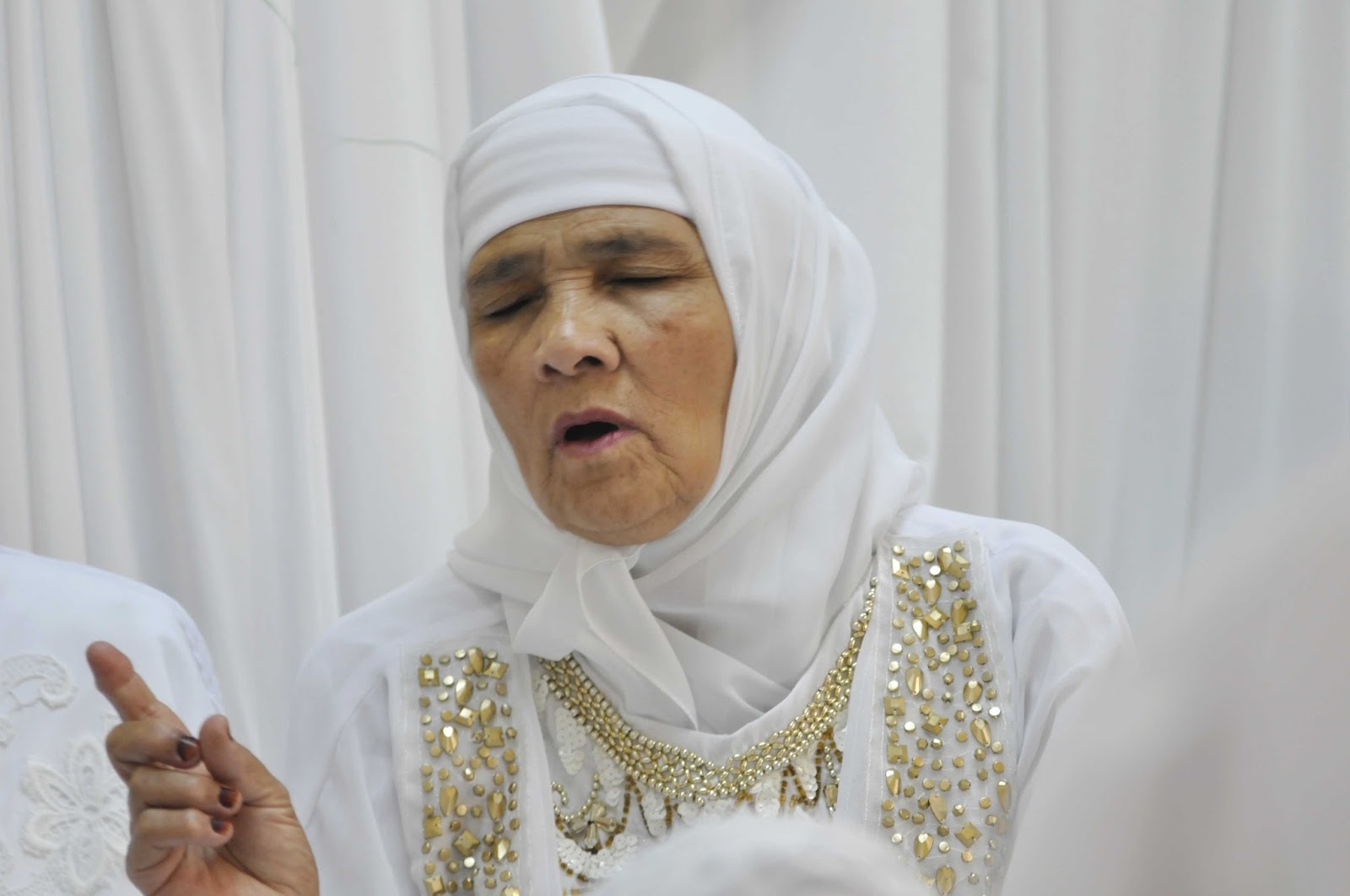
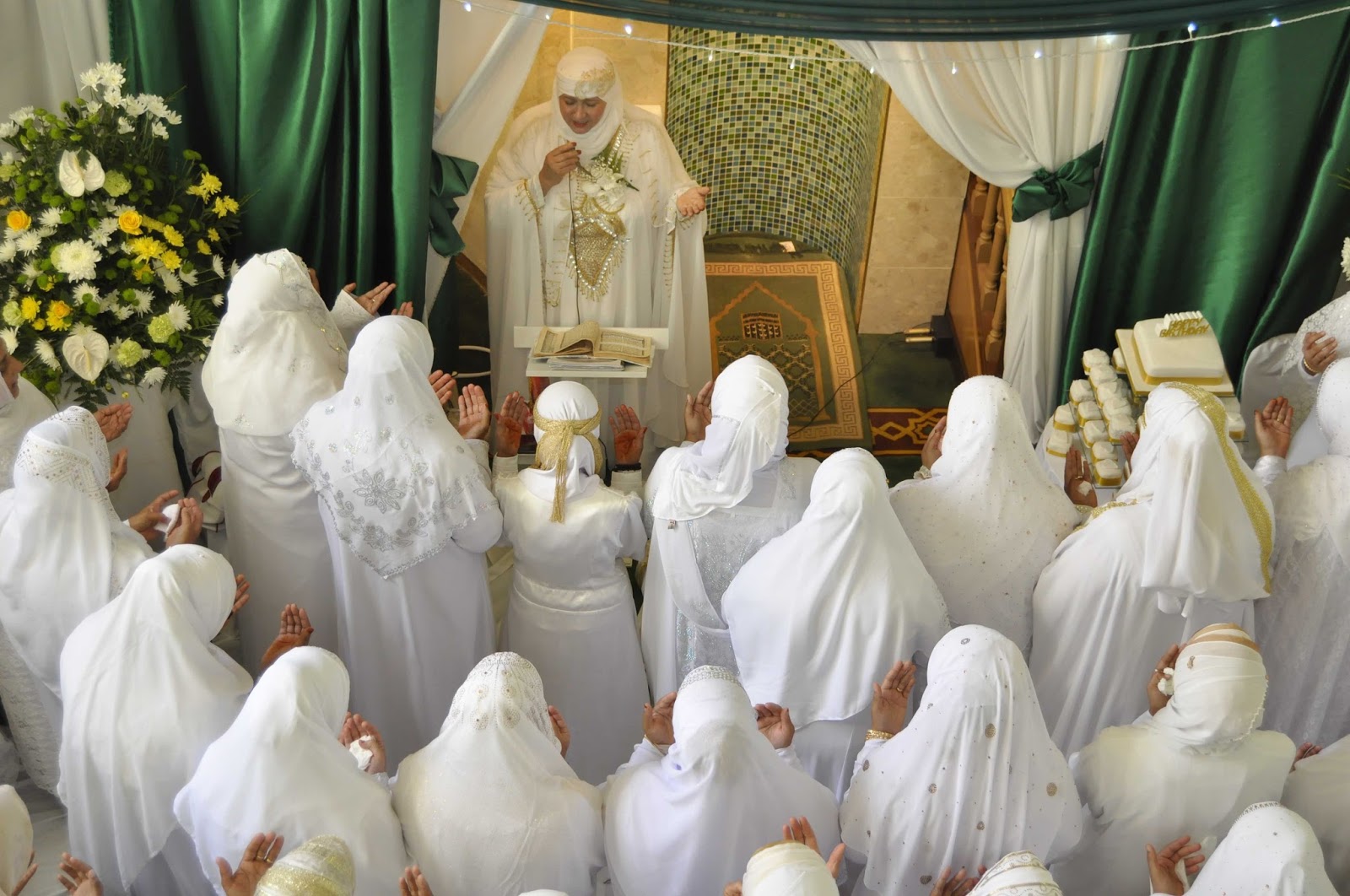
Recently, the Dairut us-Salihiyyah Dhikr Circle held their final mawlud of the season at the mosque on a cool Saturday afternoon. The mawlud, which commemorates the life of the Prophet Muhammad, was well attended and also celebrated the birthday of Hajjah Naeema, the leader of the group. Maulana Irshaad Sedick, the guest speaker, spoke about the merits of motherhood, saying it "intimidated" him that the mosque was filled with people at whose feet would lie Paradise.


Friday, February 10, 2017

Looking on the bright side of Trump

Image The Sun.
THERE is a CBS tape of Donald Trump calling Barack Obama early in the morning. A dozy Obama answers his cell by saying, “President…er…Barack here.”

When Trump identifies himself, Obama tells him that it’s the first time in eight years he’s been able to have a lie-in. Why is the President bugging him?

“I don’t sleep, I tweet,” retorts Trump sharply, who tells Obama now that he’s in the White House, what must he do? And, oh yes, what is this “politics thing?”

It is indicative of world affairs that many people would actually believe that this meme had really happened, and that an angry Donald Duck had also changed his name. In trying times laughter allows us to have a time-out from reality. In the post-truth, alternative fact era, it’s like an oxygen mask in a fart storm.

And Trump, a hot-air narcissist, has certainly given us lots of that; a man who – like Hlaudi Moetsoneng – always gives me the impression that he is talking to his mirror. He must have said “very” at least a million times during his campaign, “very serious, very bad.”  

By comparison, President George Bush II might have given us a meaningless war on an abstract noun, an illegal invasion, Guantanamo Bay, water-boarding and statements like “making the pie higher” – but – he did have a gung-ho vacuity that he was doing something, even if he didn’t know what it was; and, he did at least look like a president.   

26,000 bombs-a-year President Obama surrounded by “yes we can” coffee mugs, was shot down by an uncooperative Republican house quicker than the drones he sent to Pakistan and Yemen. However, he did show some swagger when assassinating Bin Laden, annoying Netanyahu, negotiating with Iran and – at the last moment – refusing to veto a UN vote against Israel.

But where Trump goes – Mexico wall ‘n all – nobody knows. Incidentally, it’s an idea filched from Democrat Bill Clinton, who mooted it in 1995 to a standing ovation. I think the point is that Trump is unpredictable, unsweetened by the poisoned saccharine of international diplomacy.

That’s why he will still un-nerve the Israelis, in spite of promising to build an embassy in East Jerusalem and snuggling up to the Israeli right wing. Trump is unpredictable, and Israel doesn’t like unpredictability.

The Trump universe, which is business as usual in the form of capital and Cecil John Rhodes-like profiteering, has made its mark by condoning subliminal racism and making it the conscious new cool. That is why a supercilious buffoon like Jared Taylor of The New Century Foundation can confidently tell journalist, Jorge Ramos, that African people have an inferior intelligence, and that he would happily kick Ramos, a Hispanic, out of the US.

For many US citizens, the most problematic aspect of Trump’s policies has been his Islamophobia. But again, this is nothing new. Most have forgotten the Anti-Terrorism Act of 1996, which gave immigration authorities the power to deport green card holders. After 9/11 the legislation morphed into the Patriot Act which went from focusing on Palestinians to Muslims.

Apart from Trump’s bizarre travel bans on Muslims – whom he thinks carry bombs or WMDs in their travel bags – he has exempted the countries most responsible for the export of terror, Pakistan and Saudi Arabia, but clamped down on countries such as Syria, Iraq, Yemen, Iran, Libya, Somalia and Sudan.  

But ironically, very ironically – to borrow a Trumpian phrase – Trump has managed to shoot his own foot on Islamophobia. Decent Americans have revolted against his supremacist notions and Twitter decrees by embracing Muslims in large numbers.

After 9/11 I was told that one couldn’t find an English-translation Qur’an anywhere in the US. In 2012 the New York Times reported that a Religion Census had showed that due to immigration and conversion, the amount of Muslims in the US had risen 67% since 9/11. A researcher had ventured that the anti-Islam sentiment after 9/11 could have had something to do with the increase in numbers.

In 2017 the situation has been even more extraordinary. People such as Abbas Durab, a second-generation US citizen of Afghani descent, have expressed to me their utter amazement to see US Muslims praying at airports, and in public spaces, whilst being protected by fellow citizens during protests.

Hasan Minhaj, who appears on Trevor Noah’s Late Night show, said that he was also gobsmacked by the response, saying that white people had rushed up to him and hugged him for being Muslim. Whilst he was talking with a comic edge, his amazement that his Muslim-ness had been acknowledged for the first time in 31 years, was genuine.

Durab informed me there were unprecedented scenes at the famous Women’s March, when being photographed with a Hijabi almost became something of a status symbol.

But where Trump has already made his mark is that by default, and definitely not presidential design, he has ensured that Islam will become mainstream in the US. By selectively targeting Muslims he has exposed Islam. By demonising Islam he has stimulated a curiosity, something which many will no doubt explore like they did after 9/11.

From now on Muslims doing normal things in public, like wearing hijab, fezzes, turbans and thawbs (robes) will be regarded as normal. Things like people praying in public spaces will also become normal. Going to mosque will be normal. Mosques will be normal. Muslims will be normal.

Of course, the Klu Klux Clan and the supremacist muttering classes will proclaim that the sky is falling in and that hordes of limb-cutting Orientals are massing at the gates, but it will be too late. And as they slap their holsters and tote their Smith and Wesson’s, all that they will have to shoot at will be empty Mexican tequila bottles.

Thursday, February 2, 2017

The magic turns on the magician, Trump and the law of unintended consequences


“FOOLISH are those who indulge in foolish actions
Foolish are those unconscious of their festering words
And doubly foolish are those with even more foolish reactions”

These words, penned by an unknown poet, succinctly capture the notion of unintended consequences, something that in our troubled day and age enjoys painful currency. In the social sciences, unintended consequences are defined as outcomes that are not the ones always foreseen, or intended, by an action.

The term was popularised in the 20th century by American sociologist, Robert K Merton, who passed away in the 1960s. One can only imagine what his response would be to US President Trump, and the unintended consequences of his words and deeds, were he alive today.

Blinded by his vision for a re-invented – largely white America at the expense of its founding principles – Trump has energised the world for all the wrong reasons. From his bizarre trade tariff proposals to pay for Mexico’s wall, to his sexism and to his denigration of racial minorities, he has taken the fear out of bigotry.

From the war-torn streets of Aleppo to green card holders, he has raised the ugly flag of Islamophobia. He has deliberately profiled the global Muslim community by issuing a hold on immigration, by blocking Syrian refugees and by targeting seven Muslim-majority countries.

Trump, an unapologetic narcissist, has falsely informed himself of the notion that refugees – especially Muslims – harbour a sociopathic hatred for everything around them and that they are, somehow, a threat to the US. During his campaign Trump even mooted the idea of a “Muslim register”, evoking bitter memories of World War II when over 100, 000 US Japanese citizens were interred.

The absurdity of Trump’s worldview – which has at the stroke of a pen destroyed and devastated the lives of thousands – has been revealed by the Cato Institute, whose research has shown that in the past 40 years only three deaths in the US have been attributed to refugees. In other words, a US citizen in 2017 will have a one in 3.6 billion chance of being attacked by the foreigners the president so fears.

If that’s not enough, last year 23 people died at the hands of infants playing with guns – twenty-three more than those who died in the US at the hands of Muslim “terrorists”. In fact, it was discovered that Americans were more likely to be killed by home-grown fanatics, errant lawnmowers, angry cows, boiling water, rabid dogs and vending machines.

If that’s not enough, in this post-truth era, Trump’s aides have had the temerity to defend something called an “alternative fact”, which to any sane person is an untruth. YouTube has provided some entertaining material, although after the inevitable chuckles, the feeling becomes one of foreboding – more after the sinister fashion of George Orwell’s novel, 1984, than political slapstick.

Fortunately, there are still good people in the world.  And judging by the protest and the dissent, the 45th US president has not had things entirely his own way. Whilst tit-for-tat is not the wisest course, it is significant that Iraq – the country that has suffered the worst from terror – has threatened to place a travel embargo on the US.

It doesn’t take rocket science to understand the unintended consequences in the Middle East. For the already embattled Palestinian population it will mean the ultimate affront of an American embassy on occupied soil in East Jerusalem, as well as the prospect of Jewish extremists being emboldened to seize even more of the West Bank.

And as Abu Bakr al-Baghdadi hunkers down in Mosul to make ISIS’s last territorial stand, he will be able to tell gullible extremists, “I told you so.” And as Al-Qaeda forces reload their weapons in Yemen and send out the suicide bombers, they will also say, “I told you so.”

The political hypocrisy that Saudi Arabia – the country of origin of nineteen 911 hijackers – has been exempted from the Islamaphobic bans is not unnoticed. Iraqi ambassadors have told me that the impending military defeat of ISIS will be nullified by the diplomatic sloppiness of Trump. They say he will not contain terrorism, but fuel it. The esteemed Brookings Institute concurs with much of this view.

Another unintended consequence of Trumpism will emerge from the infamous Mexican wall, something supported by Israeli Prime Minister, Benjamin Netanyahu. Netanyahu, facing his own problems due to corruption, has enjoyed the diversion.

Trump’s Mexican xenophobia might well be partly informed by a lucrative cross-border drug trade run by para-military thugs, but it is a double-edged sword. Should Mexico refuse to co-operate on narcotic policing, California and Texas could soon be drowning in cocaine.

The other issue is humanitarian. The Atlantic reported on University of Arizona findings which showed increased policing resulted in more migrants dying while trying to cross the border. Significantly, there was no uptick in the amounts of people trying to enter the US, whether there was more policing or not.

If he ever does lay the foundations for his infamous Mexico wall, it is a given that Trump will waste billions of dollars’ worth of concrete and razor wire. He will, say migration experts, compound crime by encouraging syndicates to traffic migrants via other, more dangerous routes. As Marc Pierini, the former European Union ambassador to Turkey and a visiting scholar at Carnegie Europe, told The Atlantic:

“A wall can slow someone down. It can compel them to change the route they take. But when people want to cross, whatever the motivation is, they will find a way to cross.”

The well-known Palestinian author and journalist, Ramzy Baroud, posted on his Facebook page that Trump represented a fierce, unprecedented battle between normal people and the American elites and their corporate interests.

These men had “hoodwinked” ordinary Americans to support war, to hate Muslims, Mexicans and migrants. They had brainwashed the voter to blame the poor for his misfortune, to objectify and oppress women, to support government misdeeds and wars “in the name of human rights, freedom and democracy.”

Quoting an Arabic proverb, Baroud concluded by saying that with Trump the magic had turned upon the magician, and that by the time the smoke settled, the US would find itself facing a changed and likely irreversible political reality.


Tuesday, January 31, 2017

Remembrance at Habibia, Cape Town


A PLEASANT Saturday afternoon was spent by the Dairat us-Salihiyya Dhikr Circle remebering their Creator at the gravesite of Maulana Abdul Latief in Rylands, Cape Town. The Maulana, one of Cape Town's pioneers of Islam, is regarded as a saint, or a friend of God.

Maulana Abdul Latief was sent to the Cape by another great figure, Sufi Saheb of Riverside in Durban, in 1904. In those days, Rylands Estate - formerly Doornhoogte -  was bush. The first foundation stone of the Habibia Mosque was laid on a spot of land that Sufi Saheb had purchased. Maulana Abdul Latief had to endure great hardship, living in a shack without running water as he built up an institution that today hosts a creche, a primary school and the International Peace University South Africa (IPSA). A high school and an orphanage were relocated.

Maulana Abdul Latief passed away in 1917 and his burial place is situated next to the mosque, which has been renovated to meet the needs of a growing and vibrant community.


Wednesday, January 25, 2017

Post Truth, the Big Brother of disinformation


MY first piece for Muslim Views for 2017 was meant to be a rediscovery of Shaikh Yusuf of Makasar. But events in Syria over the holiday period have presented more pressing issues, so Shaikh Yusuf is on the back-burner for now. This is because Syria has typified everything that has been going on in the media in the past year, an annus horribilis for us journalists covering world events.

What caught my attention was that the Oxford Dictionary had voted ‘post truth’ the word of the year. By definition, post-truth is when objectivity – or reason – becomes less influential than truth in shaping public opinion. To put it more bluntly, the post-truth era gives public figures the licence to lie.

The US comedian, Steven Colbert, called it ‘truthiness’, a belief that what you feel is true rather than what the facts support. In this scenario, it makes it easy to find a Zionist under every bush, or the forces of white capitalism behind every corrupted South African politician.

The Syrian conflict, representing a myriad of agendas from at least six foreign players, has been the worst victim. And when states can spread falsehood with such sophistication – as the US, Israel, Russia and Iran can – post-truth becomes a dangerous and divisive thing. Is Syria a US-Russia Cold War play? Is it about gas pipelines? Is it about the so-called ‘Shi’ah crescent?’

Most of us hear only what we want to hear, and the consequences are far reaching. It’s a cliché, but we do live in a worldwide village of overwhelming data – raw unprocessed data – and in this digital universe there is always someone prepared to pedal our worldview, despite its unreality.

In other words, conspiracy theories can be created at will. Climate change can be dismissed; politicians can use non-sequitir, or blame ghostly third forces, when facing our serious questions on economics, governance and accountability. Truth becomes relative, and not the absolute it should be.

The prime example of this is Donald Trump, a congenital liar tapping randomly into societal unease by spewing xenophobia, sexism and preying on genuine working-class fears. Indeed, Trump was click-bait deluxe; and by simply being Donald, he grabbed the headlines.

The US media, who’d feasted on his crassness, only realised too late that they’d let a genie out of a bottle. Middle America, yearning for a quick-fix to its enduring socio-economic woes, had been stirred by Trump’s armchair mantras, which sometimes hit the target, and sometimes not – except that when they didn’t nobody was listening.

Another phenomenon, together with post-truth, has been the advent of ‘fake news’ pedalled especially on Facebook and Twitter. Sometimes advertising ploys designed to generate mouse-clicks, and sometimes mischievous – or even genuinely satirical ventures – these fake news URLs have created havoc in the media.

With newsrooms already gutted by digital attrition and corporate cost-cutting, the few qualified journalists left behind have been left to deal with the damage. There is hardly a newsroom in the land that doesn’t have a list on its bulletin board naming fake news sites due their reporters having fallen for the trick.

The US website, BuzzFeed, reported that President Obama had banned the pledge of allegiance in schools. It clocked up two million hits before being found untrue. Other major fake news events were the Pope endorsing Trump, ISIS supporting Hilary Clinton and a woman defecating on her boss’s desk after winning the lottery.

Back home we had Zuma dying (several times), Mandoza passing on (he hadn’t), the government banning lobola, Trump threatening to capture Robert Mugabe and a gay baboon terrorising a village. And whilst some of the fake news is indeed funny, and difficult to take seriously, reports of people dying are not.

Where fake news and post-truth have their worst impact, however, is in parts of the world where there is conflict. When the Russian-Iranian supported advance on eastern Aleppo became news in December, it was an immediate headache. With ‘fake’ journalists abounding, from Syrian and other quarters, it became difficult to ascertain exactly what was going on.

From ‘embedded’ reporters in east Aleppo – whose phone batteries mysteriously never went flat – to Russian shills, it seemed as if one was dealing with entirely different universes. Reports varied from people cheering at Assad-aligned troops to women committing suicide at the prospect of being raped by Assad-aligned troops.  

In all of this, we journalists trying to make sense of things have also become victims – mainly of abuse – in a case of if your agenda doesn’t fit someone else’s, it becomes a case of shoot the messenger. There is no neutral space, and even humanitarian organisations have felt the trigger.

In emotionally polarised scenarios, it is so much easier for people to hang on to post-truth, than to interrogate events. Burst that bubble, and your life will become hell: the invective will be harsh, it will recognise no personal boundaries – and what is worse, it will come from mainly anonymous sources, themselves mirroring the worst of the sectarianism tearing the Middle East apart.

Of course, criticism is healthy and part of the job, but 2016 has definitely been the worst in four decades of journalism. And if we think 2017 is going to be any better, we are going to be disappointed – post-truth has been coming at us for some time, and terrifyingly, looks like it will be around for some time too.

Twenty-five years ago, a Serbian-American playwright Steve Tesich first coined the term ‘post-truth’ in an essay entitled ‘A Government of Lies’He wrote in The Nation that after Watergate and Vietnam, the US public had come to equate truth with bad news. Consequently, it didn’t want bad news anymore, no matter how vital it was to the health of the nation. “We looked to our government to protect us from the truth,” wrote Tesich.

And whilst the initial context of post-truth is an American one, this Big Brother of disinformation in our digital century has ensured that its effects will be global. The implications for the future of the world community understanding itself are frightening. And a quarter of a century later, Tesich’s words are still poignant:

“We are rapidly becoming prototypes of a people that totalitarian monsters could only drool about in their dreams. All the dictators up to now have had to work hard at suppressing the truth. We, by our actions, are saying that this is no longer necessary, that we have acquired a spiritual mechanism that can denude truth of any significance. In a very fundamental way we, as a free people, have freely decided that we want to live in some post-truth world.”

Tuesday, January 24, 2017

Mawlud, Masjid Khalil al-Rahman in District Six

A dhikr group that uses the mosque in District Six every Thursday night (all welcome) for the performance of the devotional liturgy, the Ratib ul-Haddad of Imam 'Abdullah ibn 'Alawi al-Haddad, hosted its an annual mawlud - the commemoration of the Prophet Muhammad's birth - at the mosque. The dhikr group is led by Muhammad Salih Toefy. The Ad-Dairat us-Salihiyya Dhikr Circle also joined the commemoration. Food parcels were distributed after the event.


Tuesday, January 3, 2017

The Ad-Dairat us-Salihiyyah Dhikr Circle, empowering women


THE Ad-Dairat us-Salihiyyah Dhikr Circle has a social legacy that goes back for more than 90 years when Shaikh Muhammad Salih Hendricks of the Azzawia in Cape Town initiated programmes that were to prove empowering for local Muslim women.

Having studied at Makkah at the turn of the century for 22 years, he had been steeped in the Prophetic way by his teachers, savants who were the finest exponents of classical knowledge of their age in Qur’an, Prophetic Tradition, Sacred Law, spirituality and theology.

Spending a year in Zanzibar as a Qadi (or religious judge) on the way home after the 1914-18 World War, Shaikh Muhammad Salih reached Cape Town and embarked upon a strenuous teaching programme that would see him occupied from before dawn to well after dusk on a daily basis.

Not only did he teach members of Prophet’s family – the Sayyids who’d fled the Wahhabi invasions of Makkah and Madinah in 1923 – and instruct a whole generation of imams, but he also established classes on the Ihya ‘Ulum ud-Din of the 11th century colossus, Imam al-Ghazali.

Another significant contribution was his focus on women with regards to Islamic education. So much so, that when he built the Azzawia on the slopes of Devils Peak in Walmer Estate as a Waqf Ahli (a family trust) in 1920, he decreed that the mosque space only be in the centre of the prayer hall.

The Shaikh was so keen for women to attend classes that a section extending from the walls was declared non-masjid, and women with their monthly course could attend his lessons without hindrance. Furthermore, to symbolise tolerance of the four madha-hib, or schools of thought, he built four prayer niches – or mihrabs – into the Qiblah wall.

“Die Ou Shegh” (the old Shaikh) as Shaikh Muhammad Salih was lovingly called, had a distinctive understanding of living and devotional space.

He had his house designed so that the family could move from room-to-room in complete privacy, this whilst guests ate in the dining room, or attended special classes in the front lounge. This he did by constructing a series of inter-leading doors down the one side of his residence – which itself was linked to the Azzawia via his book-lined study.

As an institution, the Azzawia had many nooks and crannies – and teaching spaces. One of them was a pillared area under the Azzawia, wrongly referred to as a “basement”. It houses storage rooms, a classroom, offices, a library and a hall.

Called the “diwan” by the old students of the Azzawia, it was here that classes were taught too, especially when Shaikh Muhammad Salih’s two sons, Shaikh Ebrahim and Shaikh Mahdi, returned from studying in Makkah in the 1940s, followed by Shaikh Mujahid in the late 1950s.

Old students remember Shaikh Ebrahim giving classes in this space, which would be enclosed by a railing and cushioned bolsters. The diwan is still used for classes for men and women – especially on Wednesday and Thursday nights – and serves as the madrasah during weekday afternoons.

Shaikh Muhammad Salih introduced the Barzanji mawlud (a poetic tribute of the Prophet Muhammad’s blessed life recited to commemorate his birth). Its melodious style of recitation – something unique to the Cape – was fine-tuned by one of his students, Ahmad Seraj.

Shaikh Muhammad Salih was the first imam to introduce the women of Cape Town to active participation in the mawlud, and they were accorded their own event, which is well-attended to this day.  

As a practioner of tasawwuf, or Islamic spirituality, Shaikh Muhammad Salih would encourage certain litanies based on the Ba ‘Alawi tradition of his Shaikhs. This is something Shaikhs Ahmad and Seraj continued when they as – third generation Shaikhs of the Hendricks family – arrived back home from studying in Makkah in 1993.  

The Dairat us-Salihiyyah Dhikr Circle was founded by the two Shaikhs and Hajjah Naeema Manie whose great-grandfather, Shaikh Mu’awiyyah Manie, had been a close friend of Shaikh Muhammad Salih. To this day, Shaikh Mu’awiyyah is the only South African Qari to enjoy the privilege of reciting the Qur’an in the Holy Mosque in Makkah.

The idea of the women’s Dhikr Circle – which salutes the legacy of Shaikh Muhammad Salih – was to broaden its base, to take the Ratib ul-Haddad litany and the mawlud to the greater community. Active for the past decade, the Ad-Dairat us-Salihiyyah Dhikr Circle has grown enormously and has expanded its activities to da’wah and social upliftment.

Its annual keynote event, the mawlud, was held at the Primrose Park masjid late in December and was addressed by the mosque's imam, Shaikh Moosa Titus. The keynote address on nubuwwah, the essence of Prophethood, was delivered by Shaikh Seraj Hendricks, who together with his brother Ahmad, is a patron of the Ad-Dairat us-Salihiyyah Dhikr Circle. 

Maulana Abdurahman Khan, a student and representative of Habib ‘Umar ibn Hafidh of Tarim, spoke about the legacy of Sayyidah Fatimah, the Prophet’s blessed daughter.

A large crowd attended.

Young and old.

Sh Seraj Hendricks delivers address.

Hajjah Naeema and Sh Seraj Hendricks.

Sh Moosa Titus addresses mawlud.

Maulana Abdurahman Khan speaks.

Time for du'ah, or reflection.

Sprinkling perfumed rose water.

Hajjah Naeema

The mawlud in progress.

The qiyam, accompanied by Sh Mujahid Toefy.

The final prayer.

Yellow roses were said to be the Prophet's favourite.

Photos Shafiq Morton