Tuesday, October 6, 2015

ISIS and the Fox journalist who got the wrong town


FOX NEWS – the brainchild of the sullied media mogul, Rupert Murdoch – may have a high viewership in the US, but it does enjoy a reputation for being irresponsibly tabloid, anti-Muslim and crassly conservative. 

So much so that TV host, Jon Stewart, once challenged Fox to a “lie off”.

So when Fox’s Johannesburg correspondent, Paul Tilsley, broke what he claimed was an exclusive story on ISIS in South Africa, I knew I would not be disappointed.

Leading with an unsubstantiated statement that “at least one South African a day” was joining “ISIS or Al-Qaeda affiliates to fight in Syria and the Middle East”, Tilsley claimed that Mayfair – one of South Africa’s most cosmopolitan suburbs – had suddenly become a no-go zone for non-Muslims.

Basing his assumption on a selective statement by the Iraqi ambassador, Dr Hisham al-Alawi, that two alleged South African ISIS fighters who’d died in Syria had come from downtown Johannesburg, he’d taken a crew to “clandestinely film” (his own words) a mosque in the suburb.

He did this instead of approaching community members or mosque congregants for comment, something that any credible journalist would have done. So when confronted by suspicious mosque goers – culturally some Muslims just don’t like photographs – he decreed that a whole Johannesburg suburb was suddenly hostile to him.

After having introduced his piece to camera by saying how many locals were flocking to join ISIS and Al-Qaeda, Tilsley comically ends up contradicting his original premise when he later quotes the Iraqi ambassador alleging that, at most, 300 South Africans could be in Syria. (For the record, community academics and Muslim clerics reckon the number to be less than 60).

Tilsley then makes a further unsubstantiated, melodramatic claim – that our security agencies have dedicated a special unit to combat South African Muslims being recruited by ISIS. This he does ostensibly to ratchet up his hyperbole to an Islamaphobic alarmism so typical of Fox – but thankfully –  not typical of the South African authorities or the South African media.  

Tilsley soon found himself under fire for his wretched journalism and got a rightful hammering on Twitter. Ironically, at the same time Tilsley was breaking his grand ISIS exclusive on Fox an Independent Group journalist, Yazeed Kamaldien, was in the reef town of Roshnee following up on the real story. Indeed, Tilsley was so bad he even got his town wrong.

Of course, the scenario of a small minority of local Muslims being desirous of joining ISIS is no secret. Even in Cape Town. Nor is it a secret that some have made their way to the war zones and have joined up with either ISIS or the Al-Qaeda-aligned Jabhat an-Nusra. And again, it is no secret that eleven (including two children) have returned.

The truth is that it is a complex narrative – far beyond Fox – that chiefly locates itself in the small reef town of Roshnee, a close-knit community where gullible people, influenced by a local “recruiter”, performed what they felt was a holy migration from an un-Islamic abode to an Islamic idyll.  

Their return from war-torn Syria via Turkey is still shrouded in mystery as their lawyer, Yousha Tayob, has fended off all our attempts to interview them and to find out exactly why they absconded from the Dawla, or the house of their dreams.

Tayob, who claims the families were not combatants – which would have made them prosecutable under the Foreign Assistance Act ­– asserts an ideological innocence on their behalf and that they went to perform “aid” or “humanitarian” work.  

However, Tayob is unable to name any aid organisations or how the aid work was done. He doesn’t know whether the group followed aid protocols or not, and can’t say what children were doing in a war zone.

These groups of about 30 people, who reportedly went to Raqqa in Syria, were joined by a Port Elizabeth cleric, Maulana Rashid Moosagee, who was described in the Washington Post as a confused, apocalyptic ideologue by South African academic, Prof Ebrahim Moosa, who knew him as a student in India.

Space precludes a detailed explanation as to how a very small minority of South African Muslims (about 0.0015 per cent of its estimated 4 million) could be wooed by ISIS, but suffice it to say that their initial failing would probably be supreme naivety. ISIS runs a sophisticated social media platform expressing a glitter of optimism, assumption and bonhomie that belies its more sinister realities.

Even Omar Hussain, the former British supermarket security guard who complained that the Syrians had bad table manners and stole his shoes, has a blog that would be believable to the unwary. His give-away line is that Muslims must not perform the Hajj to Mecca until ISIS has conquered Saudi Arabia.

The basic ISIS call to the Muslim world is Hijrah, a migration the Prophet Muhammad did in the 7th century to escape persecution in Mecca.  Based on this, Muslims are legally permitted to migrate from places of hostility to ones of peace.

ISIS – whose declaration of a Caliphate has been deemed totally bogus by Islamic jurists – claim that it is a religious imperative for Muslims to migrate to its territory. Sadly, too many Muslims around the globe have been seduced by this nonsense, and further claptrap about ISIS heralding the Armageddon and the coming of a Mahdi, an end-times imam.

In South Africa, where Muslims are arguably the freest of all minority communities, the idea of the Hijrah – or migration – becomes a parody of itself. For the migration here is in reality a backwards one. In other words, the person migrates from an abode of peace and tranquillity to one of war and social upheaval.

The point is that there is not a responsible Islamic scholar in South Africa, or elsewhere, who would ever condone such insanity. These are the voices that were so noticeably absent in the crude Fox narrative suggesting so blithely that thousands of South Africans were marching with bloodthirsty jihadis in far-flung Syria.


Friday, September 18, 2015

Staring at the moon

Photo Shafiq Morton
THERE is a view that moon-sighting, or the physical observation of the lunar crescent, is an anachronism – an out-dated methodology of determining the lunar calendar.

“Why use the naked eye when we can use technology?” is the mantra. Of course, there are advantages in technology. However, it is my argument that in the case of crescent observation, the advantages of computed and mechanical outcomes are outweighed by other factors.

This is because a reliance on calculation alone distances us from the inherent wonder of the skies and removes the positive communal aspects of moon sighting. Technology takes us away from Creation and community; it reduces the heavens to yet another material abstract, which is certainly not the message of Qur’an – as it enjoins us to marvel at what is around us.

Having been involved in Islamic calendar work for over 20 years – and having had to calculate over 300 lunar months in advance on probability – I can vouch that the stellar universe is sometimes far beyond our maths, and even the laws of physics.  

There are so many aspects to observing the lunar crescent. We have to consider its distance from the earth, its age, its lag time, its luminosity, its position in the sky and what the seasonal conditions are. It’s not just a question of age, as so many think.

These variables can also throw up surprises. There have been occasions when the crescent shouldn’t have been sighted, and it was; and there have been times when it should have been sighted, and it wasn’t. Indeed, the dictum that Allah knows best is profound – it becomes a truly humbling experience when the laws of probability are defied.

Yet in spite of this, the lunar year – based on physical observation – has always balanced itself out in terms of 29-day or 30- months, as well as the total days for the year (355). This is, I believe, its inherent miracle.

Nonetheless, there is still a certain school of thought that attributes cultural “primitiveness” to all this – with the underlying assumption that crescent observation is somehow “unscientific” or “medieval” and that it can summarily be replaced by formulae.

This, of course, betrays the fact that crescent observation (with the naked eye) is specifically mentioned in the Qur’an. The execution of Sacred Law is not my brief, and people are entitled to their views, but the calculated calendar can go awry sometimes. The observational one – as I’ve said – has its own inimitable cycles.

A lot of crescent observation has to do with experience and accumulated skills. This was proved some years ago when members of the Cape Town Observatory, armed with telescopes, asserted that the new crescent for a certain month could not be visible. To their utter amazement, the “maankykers” (as we call our observers) found the crescent within minutes and pointed it out to them.

For the hilal process (hilal is the Arabic for “crescent”) there have to be three things in place: a knowledge of fiqh (or application of Sacred Law) on crescent observation, an understanding of astronomy, and naturally, an expertise born of experience from looking at the skies.

I would suggest that the South African model of observing the crescent on a co-ordinated regional basis is the most viable. It combines the skills of a Hakim (a qualified Islamic scholar) with scientific data and the practical experience of the observers.

The final decision, adjudicated by the Hakim, is based on shura – or mutual consultation – of the observers around the country. We are one of the few minority communities in the world able to coalesce as one around this point.

This system was used in the heyday of the Islamic realm when Baghdad and Bukhara hosted the biggest observatories on earth. The scholars of the day would synthesise their fiqh and science with, yes, actual hilal observation.

Whilst there is debate on the conditions of creditworthy witnesses, I would argue that crescent observation should remain in the province of those qualified to do so. If one does not know what to look for in the sky, things such as jet streams, other planets and even cirrus clouds can be misleading.

But I have to be honest – my enthusiasm for gazing into the heavens is based on personal experience. Many years ago, I was told that the Prophet (SAW) used to look up at the skies.

When asked by his Companions why, the Messenger would answer that he was looking to see if the last days had arrived, and when he saw the stars in place, his gratitude would increase.  This may not be a reliable Hadith, but what I do take is its universal principle.

No longer do we shell peas or draw water. Modernity has many benefits. But it does distance us – as I’ve already said – from our world.

Many years ago I remember looking at the Milky Way in the Richtersveld, far from city environs, on a cold and clear night. It was overwhelming in scope. The Milky Way – a massive smear of light across the sky – had so much sparkle, scale and colour. But more significantly, as shooting stars streaked across the deep, it vibrated with energy.

On another occasion I was in the Namib Desert. It was ominously dark. But then the moon started to rise. First there was a glimmer, a luminescence and suddenly, the dunes were bathed in a soft radiance. I could see forever.

This was not an unnoticed pallid city moon with its hijab, or veil, of pollution and artificial light. This was a bursting into life, like Barzanji’s famous dedication to the Prophet (SAW): “anta badru” (you are the full moon), "anta nurun fawqan nuri” (you are light upon light).

I have never forgotten my encounters with the night skies. The ancient Egyptians were so awed by them that the Milky Way became a heavenly attribute of the Nile. However, as a Muslim I am constantly reminded of the singularity and breath-taking scope of Creation every time the new crescent is observed.

Thursday, August 6, 2015

Seeker's Hub in Azzawia, Cape Town

IT could be said that the towering spirit of the late Sayyid Muhammad 'Alawi al-Maliki (one of Islam's greatest scholars of modern times) resided in the Azzawia, Cape Town, when the Seeker's Hub's Spread Light Tour kicked off its Cape Town leg in South Africa. The Seeker's Hub, which is a world-wide internet-based school of traditional Islamic knowledge, offers classes free of charge to a wide audience via live streaming.

The gathering was addressed by Abdul Rahman Malik, director of the tour, as well as Seeker's Hub lecturers Ustadh Amjad Tarsim, Shaikh Faraz Rabbani and Shaikh Yahya Rhodus. All the brief talks centred around the comfort and succour that the Prophet Muhammad (pbuh) - as a peaceful message bearer and beacon of spiritual light - can offer to humankind in today's troubled times.

The evening concluded with nasheed (devotional poetry) recited by Sidi Nader Khan who has raised 250,00 US dollars (R3 million) for water projects in the developing world.

                                                                             Photos Copyright Shafiq Morton.

The Azzawia, Cape Town, founded 1921.

Sayyid Muhammad 'Alawi.

Malik meets Azzawia imam Shaikh Seraj Hendricks.

Sh. Seraj, a khalifah of Sayyid Muhammad, introduces guests.


Seeker's Hub is introduced.

Ustadh Amjad Tarsim.

Seekers' executive director, Canadian Sh. Faraz Rabbani.

Vote of thanks.

Sh. Yahya Rhodus address.

Sh. Yahya Rhodus, US scholar.

Sidi Nader Khan.

Sidi Nader Khan in action.

Conferral of the intellects.

Sh. Seraj at feet of Sayyid Muhammad, 1997.


Friday, July 31, 2015

Friday, July 17, 2015

Ramadan, picking the fruits

THE Qur’an is many things to many people. It is a tapestry of injunctions, prophetic history and natural wonder; it invokes Heaven and conjures up Hell; it indulges in masterful transitions. Not of literature, not of poetry and not of prose, the Qur’an is matchless.

It leads us on a journey from Surat ul-Fatihah, its opening chapter, to the final whisperings in Surat un-Nas after over 6,000 verses. Unchanged since its first uttering over 1,400 years ago, the Qur’an is the most unique text on earth.

Sublime does not begin to explain it. Qur’an can depict a galaxy in one single letter, or take a whole chapter for a universe. And every Ramadan as I dive into the Qur’an’s infinite depths, I never cease to be amazed. It is, as a famous Sufi once observed, a “Mercy Ocean”.

But also, I think Qur’an talks to us. It talks to our eyes when we scan its letters; it talks to our ears when we recite – and when we recite, the sounds resonate within each cell of our body. The Qur’an is, indubitably, a dialogue of the heart.

My interest in Qur’an, as a media practitioner, is how exactly it talks to us. The message and the medium is my daily bread, and the Qur’an is a premium message bearer, or the ultimate “Criterion”, as Allah the Highest reminds us.

And each Ramadan the Qur’an lays at our table its sweet fruits, its tastes, its textures and its tangible truths. This year my journey took me to place I’d never been before: the villains of Revelation. This was when I’d noticed how few historically bad personalities have been explicitly mentioned in its verses.

For this reason, the list of villains is not long, each representing an archetype: Iblis (who refused to prostrate to Adam), Samiri (of the golden calf) and Qarun (the wealthy Israelite swallowed by the earth). Then we have Haman (the Pharaoh’s lieutenant), Azar the idol maker, Abu Lahab and Jalut (slain by Nabi Dawud).

But the most powerful figure of all, one that towers in the text is the Fir’aun, the Pharaoh of Musa [as]. An epitome of oppressive and arrogant rule, I found his wrathful personality jumping off the page.

He was so pompous that he deigned himself divine, and indulged in unspeakable cruelty – such as chopping off the hand and foot of anyone who got in his way. The infanticide of Israelite boys is, of course, his signature atrocity.

The Fir’aun was the kind of man whose stare could chill you to the bone. That is why in Surah Ta-Ha, Musa [as] – usually plucky by nature – tells Allah when sent with Harun [as] to deliver a message to the Fir’aun, that he fears his transgressions.

It is one of the Qur’an’s most poignant moments. Allah, the Highest, calmly instructs Musa and Harun [as] to approach the Pharaoh – a man to all intents and purposes beyond redemption – with “gentle” speech in the hope that he might succumb to His Mercy. “I am with you both,” promises Allah.

The Pharaoh’s ultimate fate – to be “mummified” in abject humiliation as an unbeliever after he cynically recited that God was One to save himself from drowning – is a timeless metaphor.

This Ramadan my fruit from the orchard of the Qur’an is the fact that evil oppressors will be held accountable, whether they are ISIS emirs, or whether they are lording it in Palestine, Syria, Myanmar or Saudi Arabia. The scales of justice will weigh against them in exactly the same way they did against the Pharaoh, a man who dared to think he was god.

Thursday, July 16, 2015

Moonsighting, Cape Town, Ramadan 2015


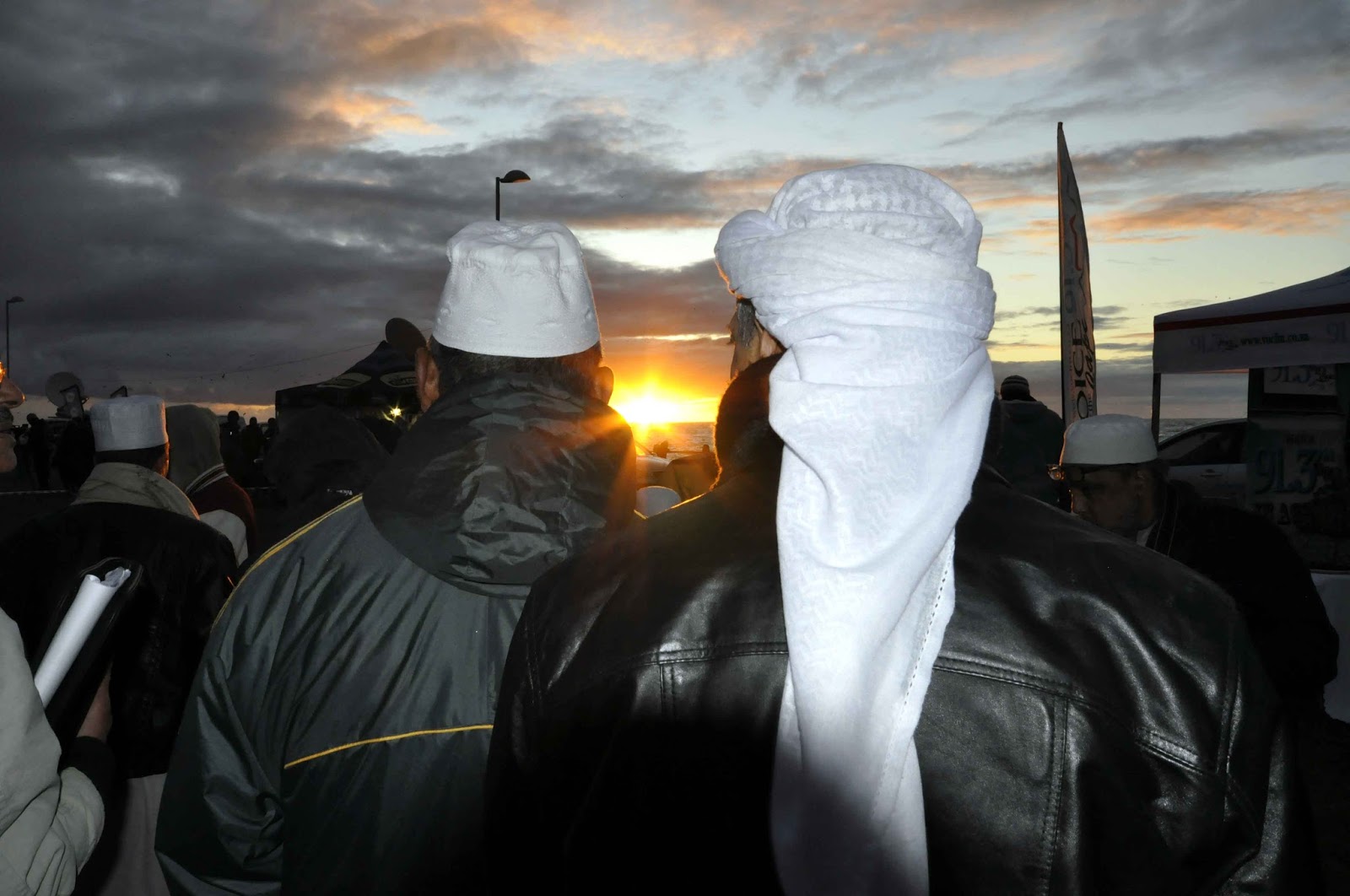
In spite of the bitter cold and rain squalls coming from the Atlantic, over 1,000 people attended the traditional moon sighting for the end of Ramadan at Three Anchor Bay in Cape Town. Crescent Observer Society Hakim, Shaikh Seraj Hendricks (second pic below), announced that the crescent had not been sighted with 'Eid ul-Fitr, the end of Ramadan celebration, taking place on 18 June.


© Shafiq Morton Photos 2015

Sunday, June 28, 2015

Islam in China: a tale of two minorities and Ilham Tohti


“SEEK knowledge, even unto China” go the words in a famous Hadith. And whilst some academics may regard this Prophetic tradition as weak, its import has real consequences. 

This is because Muslims first landed in China less than 20 years after the demise of the Prophet Muhammad. Records show that from 651-798 CE, some 39 “Arab envoys” were received by the dynastic Emperors in China.  

It is believed that Ibn Waqqas was the first Companion to travel to China, and that his grave lies in Guangzhou in the south. The oldest mosque in China, constructed in traditional pagoda style, is in Xian and was built 1,273 years ago. In fact, Islam was prevalent in China long before much of the Arab world. The Silk Route, part of which travelled over China, became the crossroads of faith and culture.
For that reason China’s early rulers were tolerant of diversity. The Ming Dynasty of the 14th century, which entertained expansionist impulses not unlike today, sent Admiral Xengh He to explore the world and to bring business to China. Xengh He, probably the finest maritime explorer of all time (who circumvented the Cape long before Bartolameu Dias) was a Muslim, a Hajji and a eunuch of great girth and height.

In 21st century China there are 20 million Muslims and some 30,000 mosques. Islam in China is a tale of two significant minorities – but one with two distinct, contrasting tales. The groups are the Hui (who originate from Ningxia in central China) and the Uyghurs (from Xinjiang in the west) a mountainous region.

The Hui, who speak Chinese, are a community going back to the earliest centuries of Islam. They have Arabic, Persian, Asian and Mongol DNA and constitute about half of China’s Muslims. The Hui have also moved to Gansu, Qinghai, Mongolia, and the northern Chinese provinces as far as Tibet.

Islam is said to have been introduced to the Uyghurs from the 10th century onwards. The Uyghurs, Turkmen who are not ethnically Chinese, claim to be the original inhabitants of Xinjiang. Their home language is not Chinese.

During the Cultural Revolution of the 1960s and 1970s the Hui Muslims were severely persecuted by Mao Zedong. In those days – when religious belief was seen as being anti-state – just the ownership of a Qur’an could result in the death penalty.  

However, in 1979 the Chinese politburo started to relax its rigidity on religious practice and endorsed five faiths: Buddhism, Taoism, Islam, Catholicism, and Protestantism.

This led to a constitutional change, Article 36 of 1982 stating that citizens of the People's Republic of China had a right to enjoy freedom of religious belief. This was, nonetheless, qualified by government insisting that it had to protect what it defined as “normal religious activities”.

Since then the constitution has been applied unevenly. China is, after all, an authoritarian one-party state with a deplorable human rights record. Tibetan Buddhism, for instance, is still not recognised; the Falun Gong (a spiritual, non-political movement) has been banned completely, its members imprisoned – and according to some sources – used to bolster China’s transplant market.

Even Christianity has felt the heat. Human Rights Watch reports that in 2013, authorities removed 150 crosses from churches in the Zhejiang province, and that China has not responded to Pope Francis’ wish to normalise relations. 

For the Uyghurs, it has been a battle for survival under extremely repressive conditions. The Hui, on the other hand, who are more of a merchant class, have assimilated fairly successfully into the broader, Han-dominated society. 

Unlike the Uyghurs, the Hui are free to wear the hijab, to grow beards, to fast in Ramadan, to construct mosques and to attend mass ‘Eid prayers. The Hui, who speak Chinese, are by definition Chinese and Muslim – whilst the Uyghurs who have their own Turkic language, do not see themselves the same way. They are Uyghurs and Muslim, not Chinese and Uyghur. This is what alarms Beijing so much – Uyghur notions of ethnic and national separatism.

The Chinese government’s response has been to squash any notion of Uyghur identity, or thoughts of an East Turkmenistan. For not only have they flooded the Xinjiang region with Han migrations (thus creating ethnic tensions), but they’ve also adopted the expedient excuse of using the “War on Terror” to crush the cultural marrow out of Uyghur bones.

It’s a political game, first and foremost, although (as we’ve said) Beijing conveniently hides behind the skirts of Islamic terror. The point is if the Uyghurs were Christian or Buddhist, they would probably be treated in exactly the same way. But that does not diminish the abuse of human rights in Xinjiang where long beards have been banned, as have veils, hijabs, and t-shirts with the Islamic crescent moon and star – and where during the month of Ramadan, fasting is banned for state employees. 

The nature of the Beijing’s Uyghur crackdown – which was intensified in 2014 – is draconian in the extreme. Late last year the academic Ilham Tohti was jailed for life on the ill-defined charge of “separatism”. 

Amnesty International described his trial and sentence as an “affront to justice”, adding that before the trial he’d been tortured, denied food for 10 days and shackled for nearly three weeks. In addition, his legal team had been denied access to him for six months, his first legal representative being pressured to step down.

Tohti, a peace activist, had been campaigning for better relations between the Uyghur population in Xinjiang and the ruling Han. He had started the website Uyghur Online and had written extensively on human rights, daring to criticise Beijing. 

It is sad, if not ironic, that nobody in the Muslim community – let alone the broader one – knows who Ilham Tohti is. Well, let’s say it: Ilham Tohti is a prisoner of conscience.  Ilham Tohti might have been caged by the Chinese oligarchs for now, but if we have any sense of justice, he will not be forgotten.