Monday, February 11, 2013

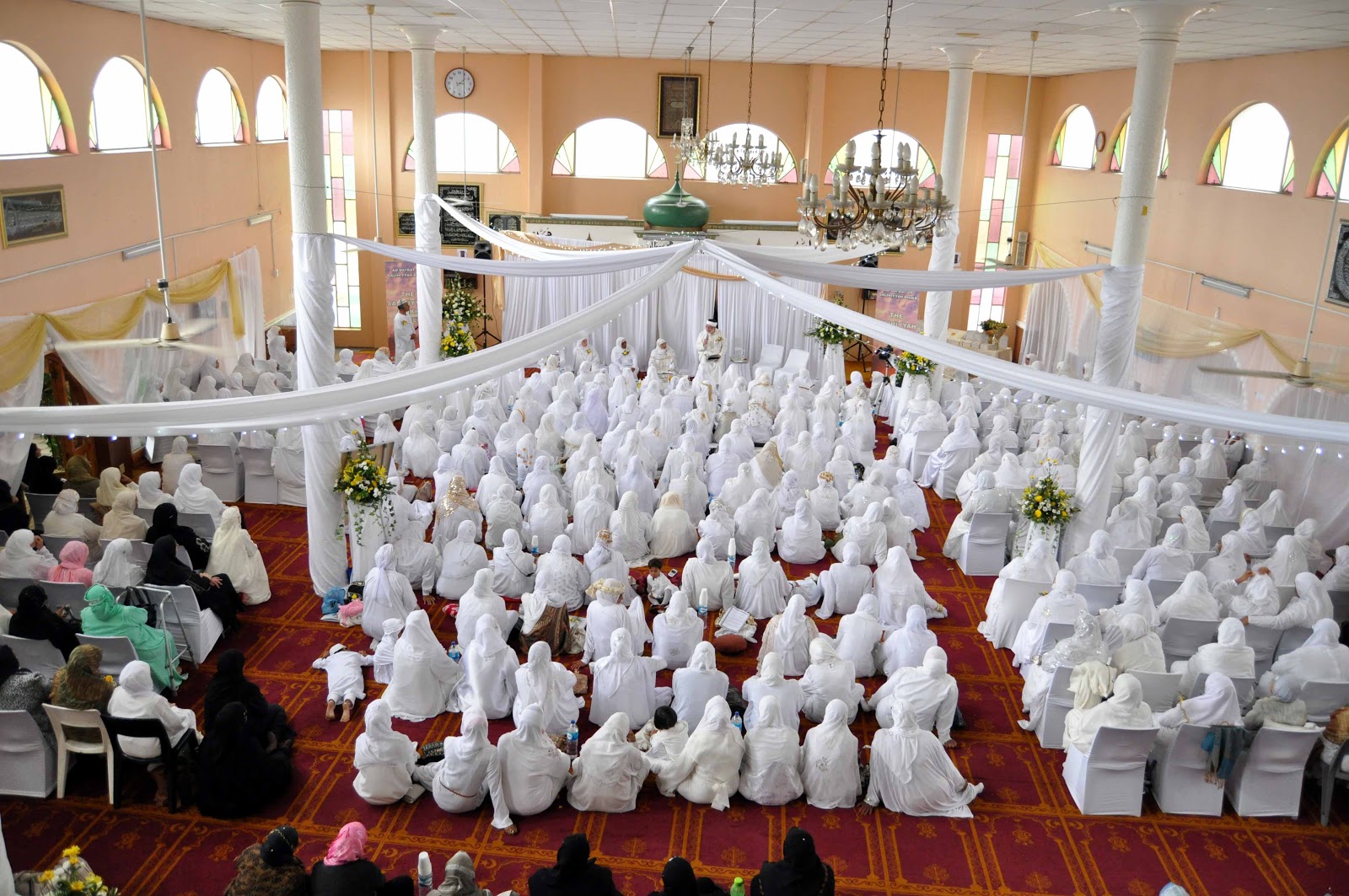
Mawlid: Ad-Dai'rat As-Salihiyyah Dhikr Group, Cape Town

The Mawlid was held on Saturday, 9 February, at the the Primrose Park mosque, Masjid us-Sabr, in Cape Town. The guest speaker was Shaikh Seraj Hendricks of the Azzawia in Walmer Estate. The group, which celebrated its tenth anniversary is led by Hajjah Naeema Manie.


© Shafiq Morton

Thursday, February 7, 2013

Mawlid SA 1434 - an international event


MAWLID SA 1434, Cape Town’s mass celebration of the Prophet Muhammad’s (SAW) birth at the Urban Park in Green Point, was a historical event marking a joyous demonstration of Islam in a public space.

Inspired by a similar event six decades ago – when Maulana Abdul ‘Alim Siddique addressed the community at the old Green Point Track – the mawlid was intended by the organisers to represent prophetic harmony and light.

Put together in less than two months by a group of scholars and community activists, the idea of Mawlid SA 1434 created huge interest and was well-received by the media who widely covered it.

The only negativity came from the anti-mawlid camp, a group of anonymous killjoys, who condemned the event as a reprehensible innovation. Its faceless captains subsequently declared that a curse would befall the mother city.

Curse or not, the organisers certainly faced some daunting challenges. The night before a gale-force south-easterly shredded the VIP marquee, and the city authorities (fearing the stage would collapse in the wind) demanded the next day that before the mawlid could go ahead its superstructure had to be dismantled.

And if that wasn’t enough, the simultaneous visit of Deputy President Kgalema Motlante, provincial Premier Helen Zille and Mayor Patricia de Lille had created an organisational nightmare – the clearing of the park for a bomb sweep.

So when I arrived early on Sunday morning at 8 am, and decided to take a short cut to the main arena from the Green Point lighthouse, I discovered that the gates had been locked. Hundreds of people were waiting to get in. Some told me they’d been waiting since 6.30, but apart from a few grumbles, most were remarkably phlegmatic .

At the stadium end of the park there was a sea of white. Things were happening there. The Reddam rugby field, originally set aside for overflow from the main arena, was already filling up with brightly coloured umbrellas and family groups. At the main gate I spotted three x-ray scanners and teams of security officials in fluorescent bibs.

That was bad news. Bureaucracy had put a serious spoke in the wheel. It would not only mean the scheduled opening procession of Islamic schools and mawlid congegrations would be almost impossible, but that even more frustrating delays would be on the cards.

Eventually, to the relief of the organisers, Mawlid SA 1434 started at 11 am when Premier Helen Zille, accompanied by Shaikh Abdurahman Alexander and the Siddique Pipe Band, entered the park.

The rest of the people, having now waited patiently for hours, trickled through the gates and the arena filled up. Considering the interminably long wait, I discovered that again – apart from a few complaints – most in the crowd were good-natured and determined to see the positive side of things.

City officials told me that about 16,000 had braved the elements (and the red-tape). I thought: What would the anti-mawlid camp, probably choking on their halal-certified coffee, say now?

“Shafiq, this reminds me of Mina!” shouted a cheerful Hajjah, who told me that neither the government nor the windy weather would put her off celebrating the mawlid.

“It’s our day and I’m going to enjoy myself with my family and my friends,” she said as she opened a camp chair and her son offered me a koeksuster. Only in Cape Town, I thought, only in Cape Town.

Meanwhile, on stage VIP’s faced the teeth of the south-easterly in the blistering sun as the stage had been stripped down to bare scaffolding. Marius Fransman (Western Cape leader of the ANC), Maulana Igshan Hendricks (President Muslim Judicial Council), Deputy-President Kgalema Motlante, Premier Helen Zille and Mayor Patricia de Lille sat in a row.

As the speeches commenced, I was asked whether the mawlid had become a political rally. I replied that I didn’t think so.

“Surely we’ve come to celebrate the Prophet (SAW), not our politicians,” insisted this person who – like so many others – had patiently waited to enter the park.

But as the event wore on I began to sense that there was a much bigger picture. None of the politicians made “political” speeches. Forget about vote catching for a moment, our leaders were saying good things about Islam and the Prophet (SAW) in a country where Muslims were not even 5% of the population.

When main guest speaker, Shaikh Yahya Ninowy (a descendant of the Prophetic House) spoke eloquently about the prophet Sulaiman (as), I began to realise that this mawlid was less about politics and more about our unique, polyglot South African identity in the image of the Prophet (SAW).

For sitting in the assembly was a rainbow community peacefully enjoying a day in Cape Town’s mid-summer sun. I’m cynical about politicians at the best of times, yet our leaders – representing different parties and faiths – were not squabbling, but listening politely to a Sufi Shaikh from the US.  

For Motlante, De Lille and Fransman it was an enjoyment of public space once denied to them by apartheid’s masters. If the mawlid had been held in 1985 the Urban Park would have been a sea of riot police. It might have been 18 years after 1994, but being there amongst fellow South Africans was still a triumph – and an affirmation of our collective identity.  

But there was something else too. The whole week I’d been getting messages from abroad expressing great interest in Mawlid SA 1434.

“Wish I was there,” was a sentiment I’d heard expressed in numerous Tweets and Facebook messages from Kuala Lumpur to Cairo. Some of the messages were not without envy that the Cape Town community could host such a significant public occasion, and attract not only the mayor and provincial premier, but the Deputy President of the country as well.

There was no doubt that Mawlid SA 1434, streaming live on radio and television, was being watched by the world. Mawlid SA 1434 was not just 16,000 Capetonians gathered on the grass in Green Point, it was an international event.


Monday, January 28, 2013

Mawlud Azzawia, Cape Town

Mawlud weekend at the Azzawia, Cape Town. Jumuáh addressed by Shaikh Muhammad Yayha Ninowy al-Hussaini, a descendant of the Prophet Muhammad (pbuh) followed by the children's Mawlud on Saturday addressed by Shaikh Seraj Hendricks.


Thursday, January 24, 2013

Mawlud un-Nabi – Cape Town Muslims to honour Prophet (SAW) in thousands

Copyright Shafiq Morton
Historically, prophetic icons are celebrated for their distinctive qualities: Jesus for turning the other cheek and for reviving the dead; Moses for the Ten Commandments and wanting to see God; Vishnu for his pantheon of rebirth and Buddha for achieving nirvana, or spiritual perfection.

And whilst there is often scant biographical detail about their actual lives, a prophetic personality exists in the mind of every believer. For their devotees, Jesus, Moses, Vishnu and Buddha are not legendary, but very real.

Another historical figure hugely alive in the human psyche is Muhammad (SAW), the 7th century prophet of Islam, whose name means “the Praised One.”. His 23-year ministry was not only a devotional prophethood, but one of great learning. “Seek knowledge, even unto China,” was one of his most famous maxims.

For an unlettered man, his legacy is remarkable. He would subsequently inspire an academic efflorescence that would spread to the rest of the world from the sands of Arabia. The universities of Baghdad, Cordoba – and even Bukhara – would produce scholars whose influence would endure for centuries.

Algebra, astronomy, physics, chemistry, medicine, optics, musicology and philosophy were all refined by Islamic scholars such as Averroes, Avicenna and Al-Kharazmi. The 9th century engineer, Abbas ibn Firnas, would even experiment with flight.

In its heyday Cairo’s hospital could accommodate 8,000 beds, and when the library of St Gall could only offer 36 books, the library of Cordoba could boast 50,000 volumes. And when 12th century Damascus had streetlights and sewage, Londoners floundered in effluent and darkness.

Words such as “alchemy” and “alcohol” owe their derivation to Muslim chemists, and it was the mathematicians of Cordoba who introduced the zero to Europe, and its doctors who discovered the nature of smallpox.

Muslims accept Muhammad (SAW) as the amalgam of prophethood, as he is considered the last of the prophets – and a light to all humanity. What also sets Muhammad (SAW) apart from other prophets – whom he regarded as his brothers – was that every moment of his life was recorded.

Muslims know, for example, that their prophet had a silent laugh, that his black eyebrows were slightly arched, that his hair hung to his earlobes, that he walked leaning forward, that he had a long beard with a trimmed moustache and that he never raised his voice, or that he always chose the middle path.

They also know that he dined with Christians, stood up for the funeral procession of a Jew, honoured agreements with his enemies, milked his own goats, stitched his own sandals and treated women equitably.

It was Muhammad (SAW) who forbade the ancient tribes from burying their newly-born daughters – and who accepted a marriage proposal from a Meccan noblewoman, Khadijah. It was Muhammad who informed a prostitute she would find paradise because she’d given a thirsty dog water.

It was Muhammad (SAW) who forgave the Quraish of Mecca who’d persecuted, tortured and killed his followers. It was Muhammad (SAW) who forgave Hind who’d eaten the liver of his uncle, Hamzah, after a battle.

These traditions about Muhammad (SAW) – called Hadith – have been transmitted from generation-to-generation in chains of authority. Every piece of Muhammad’s (SAW) life has been recorded and graded for authenticity and context.

With some 200,000 traditions attributed to him, Muhammad (SAW) is the most accessible prophetic figurehead today. From these traditions emerge a compassionate human being with the unconditional love of Jesus, the legal majesty of Moses, the humble hospitality of Abraham and the quiet spirituality of the Buddha.

Informed by the injustice done to the image of Islam since 9/11, and the distortion of the true character of the Prophet Muhammad (SAW), a diverse group of scholars and community activists are hosting a mass commemoration of the Prophet’s birth, Mawlid SA 1434, at the Green Point Urban Park on January 27.

The event has been organised in conjunction with the Cape-based Muslim Judicial Council, and according to spokesperson Nabeweya Malick, Mawlid SA 1434 aspires to reflect in Cape Town the spirit of Prophet Muhammad’s (SAW) message.

“This message – one of peace – was not delivered at the point of the sword, but through compassion, and Muhammad (SAW) being a mercy to all universally and without exception. He was the prophet that brought us the lights of science and social justice.

“At Mawlid SA 1434 we aim to show the humble, dignified way Muslims commemorate the legacy of Muhammad (SAW) during the month of his gracious birth. We’ve invited guests from around the world to grace the mother city for our big event,” she said.

Shaikh Sayyid Ninowy from the US (and a descendant of the Prophet), Shaikh Ahmad Tijani Sidi Ben Omar and Shaikh Ahmad Qatáni al-Maliki (one of Libya’s top scholars) are among those attending.

Local guests would include the ANC’s Cyril Ramaphosa,as well as mayor Patricia de Lille and premier Helen Zille.

Malick has urged the community to participate in Mawlid SA 1434, saying that the commemoration of Prophet Muhammad’s (SAW) birth was a centuries old tradition. Mawlid SA 1434, she said, would be a “family affair” with Capetonians of all faiths welcome to join in.

She requested that those Muslims attending the commemoration of the Muhammad’s (SAW) noble birth at the Urban Park on January 27 wear white (a colour loved by the Arabian prophet). Malick said that through “unity, dignity and respect” Mawlid SA 1434 would once again show the true, welcoming face of Cape Town Islam in the spirit of its founder.

For more info access www.mawlidsa1434.org or email info@mawlidsa.org

• In the original Cape Argus op-ed (Tuesday, January 22) the appellation (SAW) – peace on the Prophet – was left out due to the predominant non-Muslim readership who would not know what it meant, and who would be put off by it on the page. Those who have so rudely accused me of disrespect may not be aware of this. It is the practice of many Muslim authors and publishers when reaching a general audience to leave out the appellation of peace. It is not done out of disrespect, but rather, a consideration for other readers not familiar with this practice. In this case, it was felt that the benefits of talking about the Prophet (SAW) in a good light on the main page of a daily South African newspaper far outweighed the negatives.

Monday, January 14, 2013

Syria: is the Cold War thawing?


A Free Syrian Army fighter fires at Syrian Army positions in Tal Sheer village, north of Aleppo province, Syria, Thursday, Dec. 13, 2012. (AP Photo / Manu Brabo)
AP Photo.
WITH the Syrian death toll reportedly rising to 60,000 according to the UN, the 23 month-old uprising – which started off as a peaceful protest against President Bashar al-Assad’s regime – has developed into a conflict with Cold War overtones.

President Bashar al-Assad’s January address to the troubled Middle East nation – his first in six months – was a flowery monologue that evoked Al-Qaedah whilst giving little to his opposition and even less to the international community. UN envoy Lakhdar Ibrahimi described Assad’s speech as a “lost opportunity”.

Or as Syrian media activist, Ahmad Rahban, commented: the only new thing in Assad’s address (in which he mooted political transition on the one hand, and a refusal to deal with “terrorists” on the other) was his reference to the resistance as a coalition of “soap bubbles”.

The problem, as many Syrian commentators have pointed out, is that the key dramatis personae in the conflict – Iran, Russia, China, Turkey, Israel, Qatar and Saudi Arabia – all have their own geo-political agendas.

And while the bull elephants trample the grass, says Sami Ibrahim of the Syrian Network for Human Rights, the welfare of the beleaguered Syrian population appears to be the least consideration. A massive humanitarian disaster is unfolding.

Apart from 4 million Syrians being internal refugees, the UNCHR estimates that there are some 750,000 refugees in neighbouring states such as Turkey and Jordan. This means that a quarter of the Syrian population has already been displaced by the conflict. To make matters worse, Syrian government forces have been widely accused of war crimes.

In the meantime, the Friends of Syria – an assembly of nations convened by the US outside the UN Security Council in the light of Chinese and Russian vetoes on sanctioning Assad – has made little progress.

But then, the UN-approved Action Group for Syria (which included Russia and China) and which outlined a six-point peace plan in June last year, failed to make an impact too. It saw special envoy Kofi Annan resigning in frustration.

The US, traditionally a powerful broker in the Middle East and NATO, has been cautious on direct engagement. The Security Council vetoes by Russia and China have also assured that Syria will not go the way of Libya. NATO forces will not be taking out Assad’s airforce.

However, the interests of China and Russia in Syria are not the same. China has invested in Syria’s oil industry and is a major trade partner, but not to the extent where economic losses in Syria would trouble Beijing too much.

Nicholas Wong, writing for Open Democracy, suggests that whilst China wants to protect its strategic interests in the Middle East, it is also trying to ensure that a pro-west, pro-US (thus anti-Chinese) government does not replace Assad’s regime.

This, he hints, is one of China’s concerns about the effects of the Arab Spring. By backing Syria, China prevents the political dominoes from falling into Iran, a strategic “anti-western” cohort.

In the case of Russia, it’s a re-visiting of the Cold War era to counter US influence. Russia’s relationship with Syria goes back to the 1950’s. The Syrian port of Tartus is Russia’s last naval base in the Middle East.

Iran’s alliance with Assad and Hizballah is often portrayed as a Shi’ah alliance, but it is not the honest answer. The ruling Alawite clan, a 10% minority which controls Syria via its own network and a Sunni elite, embraces an eclectic mixture of beliefs foreign to Shi’ah Islam.

The truth is that Iran’s long-standing alliance with Syria is more political than religious. It is centred on Iran’s regional interests and the balance of power, especially in Lebanon.

Saudi Arabia and Qatar have supported the Syrian resistance– but for their own reasons; the blunting of what they perceive as a “Shi’ah crescent” from Iran to the Arabian Peninsula. The Shi’ah constitutes nearly 20% of the Saudi population, and a significant percentage in the Gulf. They are the unwelcome elephants in the Arabian room.

Turkey, a Euro-Asian power, had mended its fences with Syria after decades of post-colonial tension. But skirmishes close to its southern territory saw another chilling of detente with Damascus.

The Turks have taken in over 300,000 refugees and have worked quietly, and mostly behind the scenes, with the IHH – a Turkish humanitarian organisation –successfully negotiating the release of 48 opposition-held Iranian Republican Guards for 2,000 Syrians held in Assad’s jails.

For the Israeli house, jittery about the Golan Heights and Hizballah in Lebanon, Assad has been a case of the devil you know. Israel’s recent air-raid on Syrian territory against an alleged arms convoy travelling to Lebanon was not only a pre-emptive strike at Hizballah, but Iran.

Given the impasse – the intransigence of Assad and the inability of the opposition to coalesce – the rise to prominence of Mouaz al-Khatib, a geophysicist and Islamic cleric, as an identifiable leader of the Syrian Opposition Coalition has been hugely significant. It could finally offer some hope.

A proponent of political plurality who sees dialogue not as surrender, but the lesser of two evils, he has recently met with the Foreign Ministers of Iran, Russia and the US vice-president, Joe Biden.

Syrian opposition sources told me this week that Al-Khatib’s offer to enter into a dialogue with Syrian vice-president Farouk al-Sharaa – on the condition that 160,000 political detainees be released – is not only a calling of Assad’s bluff, but could be an important step towards negotiating a transitional government.

Even Moscow is showing a subtle shift. Russian Prime Minister Dmitri Medvedev suggested, in a rare criticism of Assad, that his refusal to engage in dialogue was not good for Syria. Media activist, Ahmad Raban, said the leaders had begun to realise that the bloodshed could not continue.

“Things are really bad. Five thousand people are dying every month. We Syrians have been forgotten. The world must act as one to stop the violence,”he said.


Thursday, January 10, 2013

District Six Moods


 Aspeling Street minaret. Victorian  masterpiece.


South-east clouds roll over mountain like a wave.

Muir Street.

Aspeling Street against backdrop.

In Muir Street mosque.

Cat on a hot green roof, Azzawia, Walmer Estate.

New Year in full glory.  

 Photos copyright Shafiq Morton.

Wednesday, December 19, 2012

The Bidáh of the Mawlud - a Dialogue with Bin ul-Faragh

“Don’t you people know that the mawlud is a bid’ah? Don’t you people know it’s haraam to celebrate birthdays!” blurted-out the man (whom I will call Bin ul-Faragh). We were at one of those social gatherings so typical of our community where we sit at hired trestle tables.

We’d been discussing the mawlud, and Bin ul-Faragh had been unable to contain himself. Every family has its Bin ul-Faraghs. But we were in a cramped space, and there was no such thing as an easy, diplomatic getaway.

I could see those around me shifting uneasily with embarrassment. They knew, like I did, that “you people” was a rhetorical challenge – and the harbinger of unavoidable confrontation. I had to think quickly on my feet to avoid it.

“I agree. The commemoration of the Prophet’s (SAW) birthday is a bid’ah. The mawlud is an innovation, you are dead right, brother,” I answered, “if you don’t like it, stay away from it.”

“Whaddaya mean?” Bin ul-Faragh’s head snapped back in surprise. “So you, Shafiq Morton, say mawlud is shirk then? You admit that the mawlud isn’t mentioned in Qur’an and Sunnah? You admit that the Prophet (SAW) didn’t celebrate birthdays in his lifetime?”

He was now speaking with a raised voice. Others began to fall silent in the crowded room, turning from their chatter to see what the source of the commotion was. Instead of damping the flames, I’d only stoked the fire in Bin ul-Faragh.

“No, I don’t agree that the mawlud is polytheistic,” I said quietly. And facing those at my table asked whether anybody present worshipped the Prophet (SAW) as Bin ul-Faragh accused us of.

There was an uneasy silence, soon followed by utterances of “astaghfirullah” (May Allah forgive me) and very heated denial.

“Surely you’ll concede,” I added, “that the origination of the mawlud celebration is historically derived from the necessity to love – and not worship – the Prophet (SAW)?”

“Ja, man, but you people are all misguided. You people make mawlud into a Christmas carol,” retorted Bin ul-Faragh.

 “You talk about Christmas,” I said, “what about the verse in the Qur’an (19:33) where it says that peace rest upon Jesus on the day he was born? Or (19:15) when Allah Almighty declares the same about prophet Yahya (as)?

 “Then what about the admission of the Prophet (SAW) that he fasted on Mondays because it was the day he was born? He celebrated his own birthday – a blessing for mankind – every week during his lifetime.”

Bin ul-Faragh’s response was to enter into a long monologue in which I was accused of using “pre-Islamic” texts and “Zionist-influenced mischief” to argue about the permissibility of the impermissible mawlud. He suggested that I was drunk with the propaganda of my Shaikhs.

He then quoted Hadith in Arabic: “Beware of matters newly begun, for every innovation is misguidance …and every misguidance is in hell.” He had mangled the syntax by inserting a negative “ma” before the first “misguidance”.

“Brother,” I said, “you’ve totally misunderstood the context of this Prophetic axiom. Scholars agree that what’s being referred to here is something new in Islam that’s contrary to the spirit of Shari’ah, or Sacred Law. What do you say if something is not contrary to Sacred Law?”

Bin ul-Faragh glowered as those at my table tut-tutted. I went on to say that tarawih (the prayers in Ramadan), the Islamic calendar, the compilation of the Qur’an – as well as some of the utterances in the prayer – were all innovations introduced by the Prophet’s (SAW) noble Companions.  

“Are people such as Sayyidina ‘Umar (ra) in hell?” I asked.

I borrowed Shaikh Nuh Keller’s commentary on the Shafi’i scholar, Naqib al-Masri’s The Reliance of the Traveller, to explain.  The principle was that whatever was introduced to Islam in contravention of Sacred Law would be discarded, but whatever was regarded as good (and not contrary to Sacred Law) would be beneficial.

"That’s the distinction you can’t make. There’s bad bida’h and there’s good bid’ah. Good innovation is lexically an innovation, but legally speaking is actually an inferable Sunnah,” I said to Bin ul-Faragh.

“And no, I’m not going to argue that the mawlud is an issue of Fiqh (the application of Sacred Law) when it clearly isn’t, and that it might be obligatory, which it isn’t too. It’s a question of choice, a question of respect for the Prophet (SAW) and a noble way of remembering him.

“The mawlud – which is usually a recitation of the Prophet’s (SAW) life combined with the remembrance of Allah – is a social gathering that carries with it the power and grace of good intention. By its very nature it does not contravene Sacred Law.

“This is what ‘ulama over the centuries, together with the various Caliphs of the Islamic realm, have acknowledged,” I said.

I pointed out that until the 19th century the scholars of Makkah had visited the house of the Prophet (SAW) and walked to the Haram in a procession on the night of the Prophet’s (SAW) birth.

“But you people make haraam at these gatherings…you commit extravagances instead of giving to the poor,” argued Bin al-Faragh.

“Is extravagance for the sake of the Prophet (SAW) a blameworthy trait?” I asked. “Has any poor person ever been denied access to a mawlud? And what about those who give sadaqah, or charity, at that time?”

Bin ul-Faragh reddened with indignation, but the tide was turning. I could sense that the room was now against him. Cape Town, with its strong Sunni ethos and 300-year legacy of tasawwuf (or Sufism), was not the best place for petro-dollar Islam.

“I think everybody here will agree to disagree,” I said. “Nobody is forcing you to attend a mawlud, so you should not condemn those who do celebrate it as misguided.”

“But you are misguided! There are no birthdays in Islam, period. You people are going to roast in hell,” shouted Bin ul-Faragh, rising to his feet and stumbling over those sitting next to him as he rushed for the door.